Kenner
Star Wars
1977 – 1985
The line that invented the modern 3¾-inch action figure, and sold an empty box one Christmas to do it.
Meet the Molder →Hammer & Mold brings together original vintage toys, the companies that made them and the stories that made them famous. Explore the history. Watch the commercials. Buy the originals.
Live auctions on original vintage toys. Place a bid, or take it straight away with Buy now.
We organize the collection the way it was built: maker first. The maker is the molder; its toy lines live beneath it. Filter the lines by their maker, or sort them across the years.
The line that invented the modern 3¾-inch action figure, and sold an empty box one Christmas to do it.
Meet the Molder →Proton packs, ecto-plasma and gross-out mutations. The strangest, most inventive toys on the shelf.
Meet the Molder →Soft-vinyl monsters from Tokyo's tokusatsu boom. Godzilla, Ultraman and the beasts of late-night television, hand-poured and hand-painted.
Meet the Molder →Mutant reptiles, pizza and ooze. The line that turned a black-and-white comic into a worldwide phenomenon.
Meet the Molder →The gentle alien of 1982. Poseable figures, glowing fingers and the most famous bicycle in cinema.
Meet the Molder →Mr. T, machine guns and a black van. No plan survived contact, but the toys did.
Meet the Molder →The monsters you could actually own. Cheap vinyl on a hook by the till, from the company a Holocaust survivor built out of a ten-cent bouncing ball.
Meet the Molder →Britain's Star Wars line, from the company that also made Action Man. Its Death Star is printed card because plastic cost too much, which is exactly why it is now the one collectors chase.
Meet the Molder →The toys about toys. Pull-string Woody and Buzz, straight from Pixar's first feature.
Meet the Molder →Anyone can sell an old toy. We want to tell you what you're actually looking at.
Year, maker, series, scale, accessories and condition. The details collectors actually want to know.
Who made it, when it appeared and what made it special. The story behind the plastic.
The original TV commercials that introduced these toys to the world, right where they belong.
The ship that didn't make the first wave. When it finally landed in 1979, it was the biggest, most coveted toy Kenner had ever built.
In 1977, Kenner had the kind of problem most companies only dream about. Star Wars had become the biggest film on Earth, every child wanted the toys, and Kenner had almost nothing on the shelf. There was no way to tool, mold and ship figures in time for Christmas.
So they sold a promise. The Early Bird Certificate Package was, essentially, an empty box with a cardboard diorama and a mail-away voucher. Post it back, and sometime in early 1978 four action figures would arrive: Luke, Leia, R2-D2 and Chewbacca. It should have been a disaster. Instead it sold in the millions.
The figures that followed in 1978 invented a format the whole industry would copy: the 3¾-inch action figure, small enough that a child could own a galaxy. Vehicles came next. But the one everybody wanted, the flagship itself, was held back.
The Millennium Falcon did not arrive until 1979. When it did, it was enormous for its day: a light-up cockpit, a spinning radar dish, a training remote, and the little chess table from the film. It was the toy you asked for and rarely got. Forty-odd years on, a complete one is a small monument to how much a plastic ship could mean.
The full story of the line: the Early Bird gamble, the figures that changed the industry, and the eleven years that followed. Every artifact links back here.
The company that turned licenses into legends. From a toy oven that actually baked to an empty box that launched Star Wars, Kenner spent five decades deciding what a generation would find under the tree.
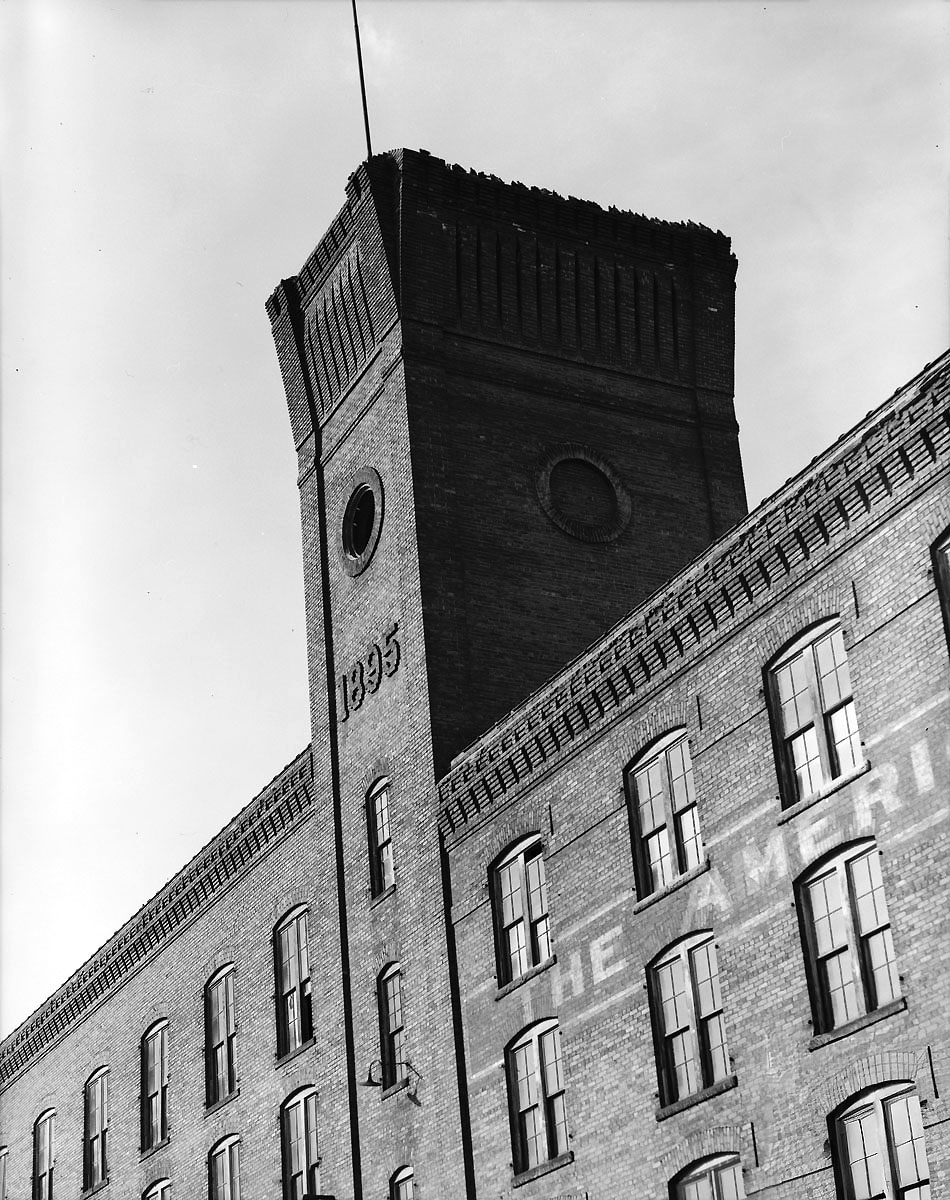
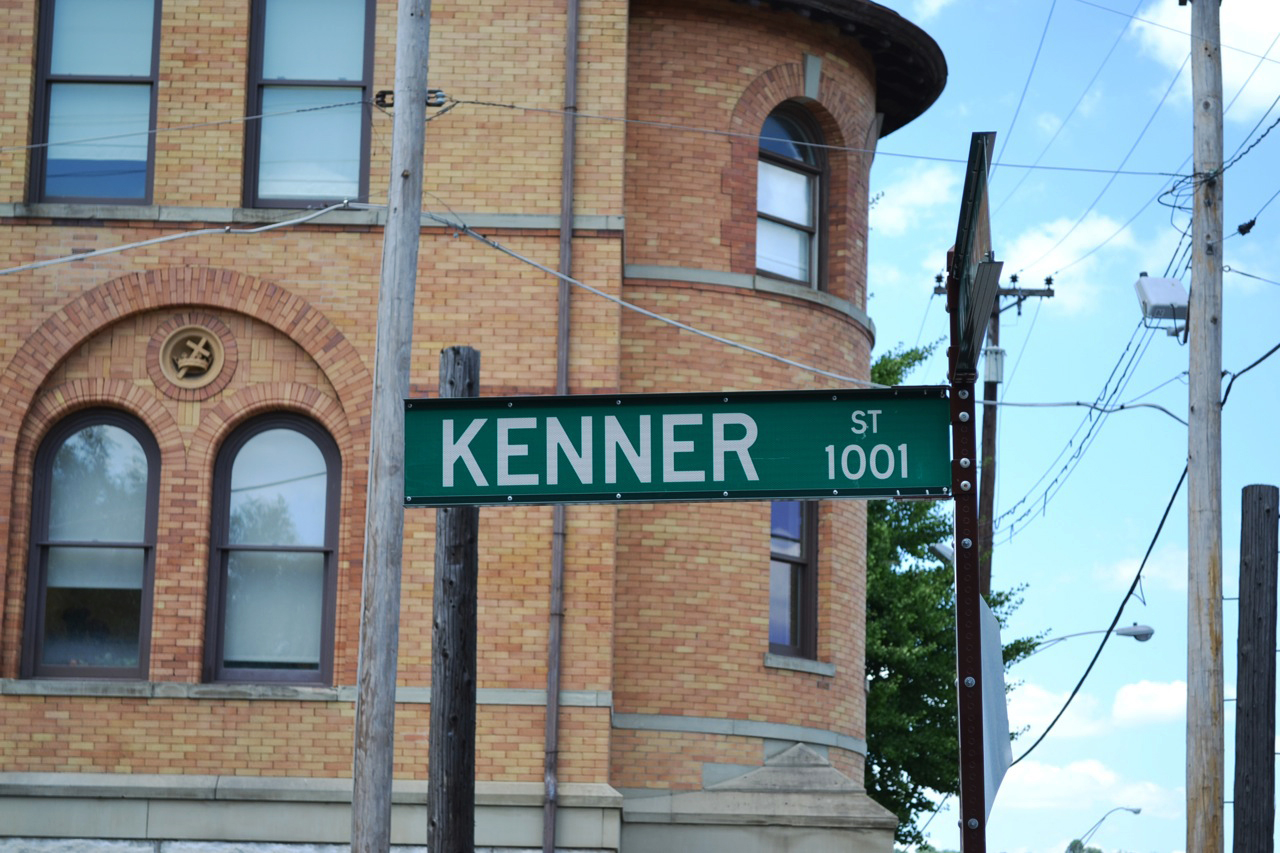
In 1947, three brothers, Albert, Philip and Joseph Steiner, started a toy company in Cincinnati, Ohio, and named it after Kenner Street, where their office stood. It was a small beginning for a firm that would end up shaping the shelves of nearly every toy shop in the Western world.
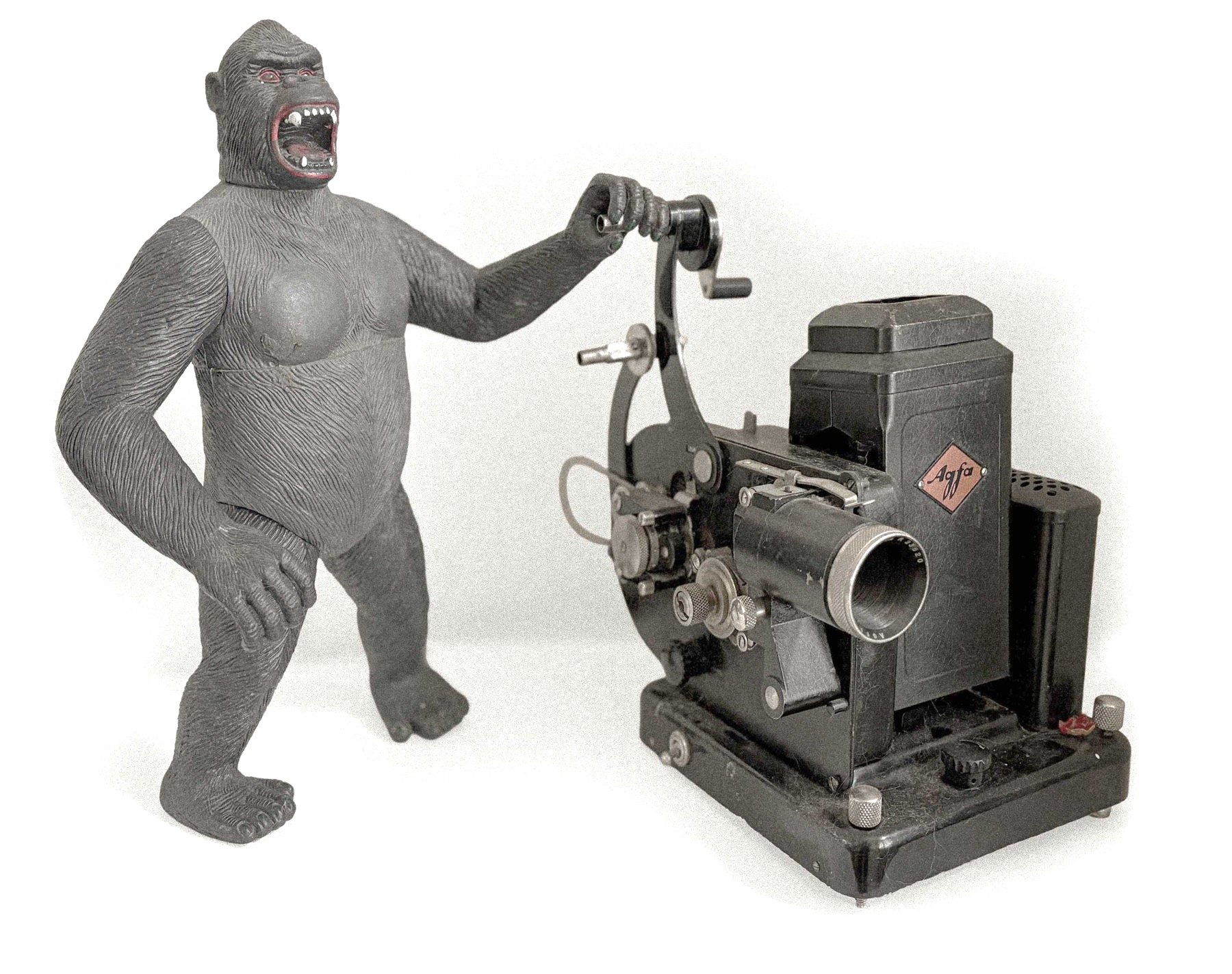
Their early hits were toys that actually did something: the Give-A-Show projector in 1959, and in 1963 the Easy-Bake Oven, a miniature oven that genuinely baked, sold by the million and never really gone. Spirograph followed in 1966, and by 1976 a rubbery strongman called Stretch Armstrong had joined them. Kenner had a knack for turning a clever idea into a phenomenon.

When Kenner won the Star Wars license in 1977, there was no way to tool, mold and ship action figures in time for Christmas. So Kenner sold a promise instead. The Early Bird Certificate was, in effect, an empty box with a mail-away voucher. Post it back, and four figures would follow in early 1978. It should have failed. It sold in the millions.
The 3¾-inch (9.5 cm) figures that arrived in 1978 set the template for action figures everywhere: small enough that a child could own a whole galaxy. Sales doubled to $200 million that year, and by 1983 more than 300 million Star Wars items had been sold. The Millennium Falcon landed in 1979, and for a while Kenner was less a toy company than a machine for manufacturing childhood.
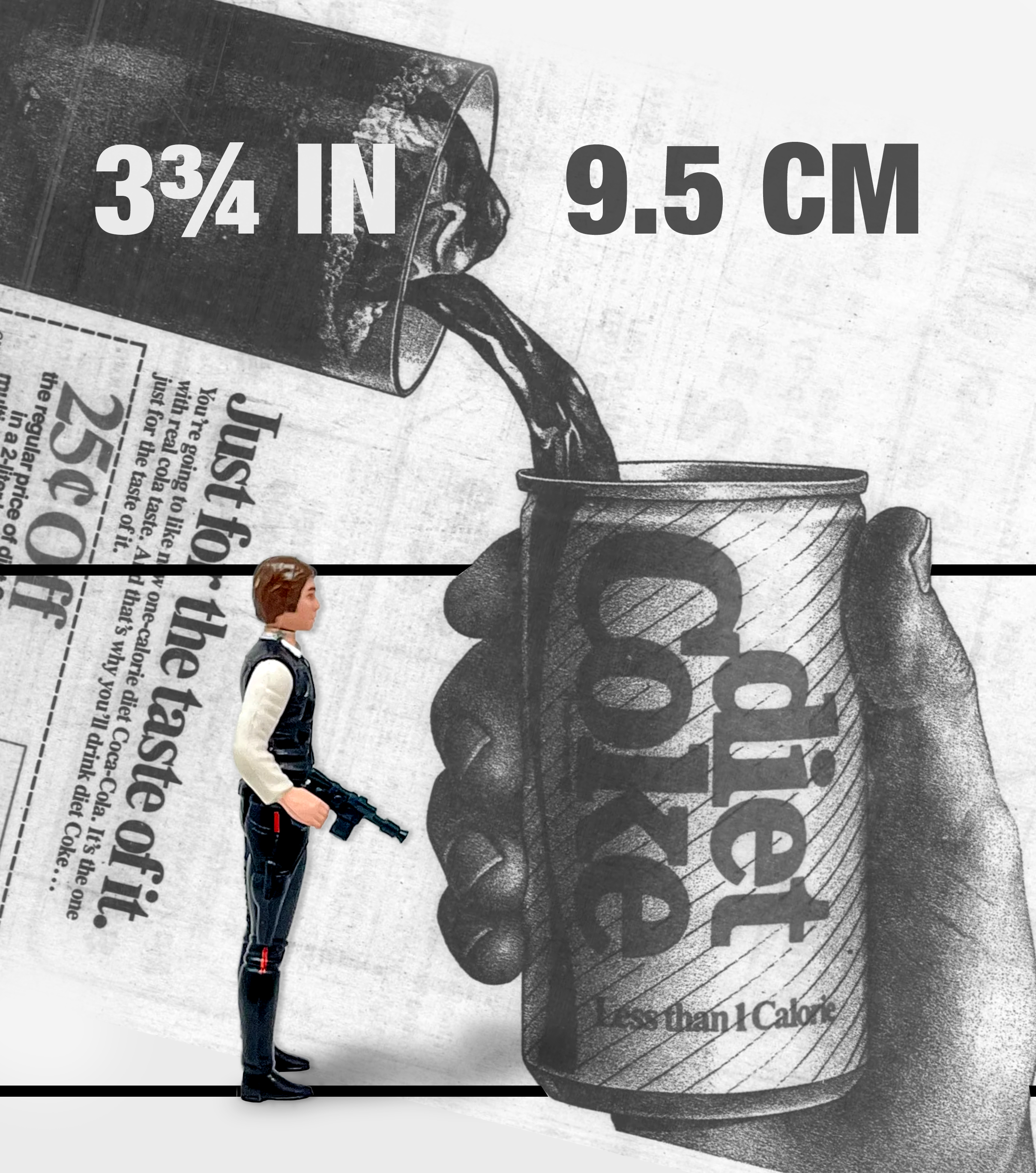
The short version of a long history: how a Cincinnati start-up became the maker behind the toys people still hunt for today.
Kenner's licenses read like a childhood. These are the ones represented in the collection.
The line that started with an empty box and ended up on every shelf. The Falcon is in the collection now.
View the toys →Proton packs, ecto-plasma and gloriously gross mutations. Pieces arriving soon.
Coming soon →Six Million Dollar Man, Strawberry Shortcake, Super Powers, Batman, Jurassic Park. A back catalog of icons.
Coming soon →The television spots that sold the toys the first time around. Six from the Kenner vault. They play inline here; the title opens the clip on YouTube.
Our own reading of the toys, checked against the public record. Follow these if you want to go further than we did.
Two cartoonists, a kitchen-table joke and an idea that got wildly out of hand. In four years the Turtles went from a 3,000-copy black-and-white parody to the action figures on every shelf in the Western world.
One night in November 1983, Kevin Eastman and Peter Laird were trading silly drawings in their apartment in Dover, New Hampshire. Eastman sketched a masked turtle standing upright with a pair of nunchucks, and scrawled three words above it as a gag: Teenage Mutant Ninja Turtles. It was a parody, poking fun at the biggest comics of the day, Frank Miller's ninjas, the New Mutants, Dave Sim's Cerebus. It was never meant to leave the room.
But they couldn't let it go. With a tax refund and a loan from Eastman's uncle, around $1,200 between them, the pair self-published a single oversized black-and-white issue in May 1984, under an imprint they invented on the spot: Mirage Studios, so named because the studio didn't really exist. They printed 3,000 copies, priced at $1.50, and mailed out a press release that made the tiny print run sound like an event. It sold out. The gritty little comic became the most talked-about book in the independent scene, and first-printing copies now change hands for the price of a car.

A licensing agent named Mark Freedman saw what the comic could become, and brought it to Playmates Toys, a modest California firm with no action-figure line of its own. Playmates was interested but cautious: they wanted the Turtles on television first, to prove the audience was really there. A five-part animated miniseries aired in December 1987, and it changed everything about them.
Television softened the Turtles into the version the world remembers. In the comic all four wore red masks; on screen each got his own color so children could tell them apart. Michelangelo got the nunchucks and the one-liners, pizza became an obsession, and a whole cast, Krang, Bebop and Rocksteady, the Technodrome, was invented for the show and the toys. When Playmates shipped the first figures in 1988 the line didn't just sell. Within two years the Turtles stood shoulder to shoulder with Star Wars and G.I. Joe as the best-selling toys on Earth.

The short version of a long story: how a parody comic became one of the biggest toy empires of its decade.
Playmates didn't just make figures. It built a whole world in plastic, and these are the pieces collectors still chase.
If the figures were the army, the Technodrome was the empire's fortress. Released in 1990, it was Krang's rolling war-machine rendered in plastic: a giant motorized eyeball that rose from the top, prison cells, a working lift, escape hatches and a firing cannon.
It is the piece almost every collector remembers begging for, and the one that still anchors a serious Turtles collection today. Complete, boxed and unbroken, it is the blue-chip of the range.

The very first vehicle. A soft vinyl blimp the Turtles flew over the city, and one of the pieces in the debut assortment.
Michelangelo's skateboard, molded to clip a figure on for the ride. One of the earliest accessories and a fixture of the early line.
The armoured van from the cartoon, complete with periscope and spring-loaded cannons. The line's signature vehicle.
The Turtles' underground lair. Trapdoors, a fold-out sewer and a working lift, the first true home base of the line.
A catapult on wheels that flung little plastic pizzas. Half vehicle, half weapon, entirely absurd.
The Foot Clan's answer to the Party Wagon, and the siege engines that filled out the villains' side of the shelf.
The television spots that sold the toys the first time around, straight from the Playmates vault. They play inline here; the title opens the clip on YouTube.
Our own reading of the toys, checked against the public record. Follow these if you want to go further than we did.
The company most people can only name by its rainbow. LJN made the first E.T. toys, the rubber wrestlers that ruled the '80s playground, and a run of games so notorious the logo became a punchline. Behind those three letters is a stranger story.
LJN was founded in New York in 1970 by Jack Friedman, and the three letters have puzzled collectors for decades. They aren't his initials. In the 1960s Friedman worked as a sales rep for a toy man named Norman J. Lewis. When he struck out on his own, he named the company after his old boss with the name reversed: Lewis J. Norman, L.J.N. It has been hiding on every box the whole time.
Friedman had a nose for a license nobody else wanted. In 1982, when Steven Spielberg's E.T. was still an unknown quantity and the big toymakers were nervous, LJN took the film rights for a reported $35,000, pocket change even then, and produced the first-ever E.T. toys. It set the pattern for everything that followed: LJN would buy the license others were too cautious to touch.

In 1984 LJN won the license for the World Wrestling Federation, and the Wrestling Superstars line changed the schoolyard. At eight inches these were giants, molded in solid rubber so they survived any beating a child could hand out. Hulk Hogan, Andre the Giant, Roddy Piper, a whole roster you could actually throw across a room. For Thundercats a year later, LJN built its clever 'Battle-Matic' spring action into the figures. For a while it could do no wrong.
Then came the other half of the story. MCA/Universal bought LJN in 1985 for around $66 million, and in 1987 the company began publishing games for the Nintendo Entertainment System. Here is the part few remember: LJN never actually made a single game. It only put its rainbow logo on titles built by others, Friday the 13th, A Nightmare on Elm Street, Back to the Future, many of them so poor that decades later the logo became internet shorthand for a bad game. Same three letters, two opposite reputations.

How a New York licensing house became a byword for both childhood treasure and gaming infamy.
The licenses that made LJN, from the treasured to the infamous.
The license nobody else wanted, and the first toys of the world's favorite alien.
Eight inches of solid rubber. The figures that ruled the '80s playground.
Lion-O and the gang, built around LJN's spring-loaded Battle-Matic action.
The rainbow chapter. Games LJN published but never made, now a byword for the era's worst.
The spots that sold LJN's giants the first time around. They play inline here; the title opens the clip on YouTube.
Our own reading of the toys, checked against the public record. Follow these if you want to go further than we did.
A family firm that began with a wind-up monkey and nearly died twice, then saved itself by making the smallest cars in the world. Galoob's back catalog hides a courtroom victory that changed gaming, and a toy recalled for putting eyes out.
Lewis and Barbara Galoob started their company in San Francisco in 1957, selling toys and stationery out of a modest operation. Their first real hit is one you have almost certainly seen even if you don't know the name: a battery-powered Jolly Chimp that banged a pair of cymbals and grinned. That same wide-eyed monkey later became horror-film shorthand for dread. It kept the lights on through the 1960s.
In 1970 Lewis fell too ill to run the business, and his 21-year-old son David dropped out of the University of Southern California to take it over. It was the first of several moments when the company's survival hung by a thread. Galoob licensed television to stay afloat, and in 1983 one of those licenses was The A-Team: Mr. T, a black van and a squad of toys that rode the show straight onto every shelf.

By 1987 Galoob was in real trouble. A run of failed electronic toys and chaos in its shift to Chinese manufacturing sent sales down 40 percent and left a loss of nearly $25 million. What pulled it back was tiny: Micro Machines, launched that year, miniature vehicles with a level of detail no one expected at that scale, sold by a fast-talking pitchman who became a phenomenon in his own right.
Two more secrets sit in the catalog. Galoob was behind the Game Genie, the cheat cartridge Nintendo sued to kill, and Galoob won the landmark case, establishing that letting players modify a game they owned was perfectly legal. And in 1994 it launched Sky Dancers, foam-winged dolls that flew when you pulled a cord, a smash hit that sold tens of millions before being recalled after the spinning wings caused eye injuries. By the time Hasbro bought Galoob in 1998 for $220 million, the wind-up-monkey company was the third-largest toymaker in America.

How a San Francisco family firm survived long enough to become America's third-largest toymaker.
The licenses and inventions that carried Galoob through four decades.
Mr. T, machine guns and a black van. The show's toys, moving as fast as the plots.
The tiny cars that saved the company, sold by the fastest mouth on television.
The cheat cartridge Nintendo went to court to stop, and lost.
A galaxy shrunk to pocket size, and one of the '90s' best-loved licenses.
Foam-winged dolls that really flew. A blockbuster, until the recall.
The fast-talking spots that made Galoob's smallest toys famous. They play inline here; the title opens the clip on YouTube.
Our own reading of the toys, checked against the public record. Follow these if you want to go further than we did.
The little Canadian toy company that made one of the smartest bets in toy history. Mattel passed. Hasbro passed. Thinkway looked at a cowboy, a spaceman and a film nobody had ever made before, and said yes.
In January 1995, Albert Chan of Thinkway Toys was at the Toronto Toy Fair when Disney's Canadian licensing team approached him with an unusual proposition. There was an animated film coming that November. Not drawn animation. Computer animation.
Chan was shown early artwork of two characters: a cowboy named Woody and a space ranger named Buzz Lightyear. Disney wanted to know whether Thinkway was interested in making the toys.
It was a much bigger gamble than it sounds today. Toy Story would be Pixar's first feature and the first feature-length film created entirely with computer animation. There was no precedent for it, and nobody knew whether an audience would sit with characters that looked like this for ninety minutes.
And there was another problem. Time. Toy companies normally wanted well over a year to develop a major film line. Thinkway had months, because Disney was shopping a Thanksgiving 1995 release at the beginning of that same year.
Mattel had passed. Hasbro had passed. Thinkway said yes.
The company went to New York the following month, presented its ideas to Disney's American team and secured the master toy licence for Toy Story. By August, Woody and Buzz were real toys. By November, the world knew exactly who they were.
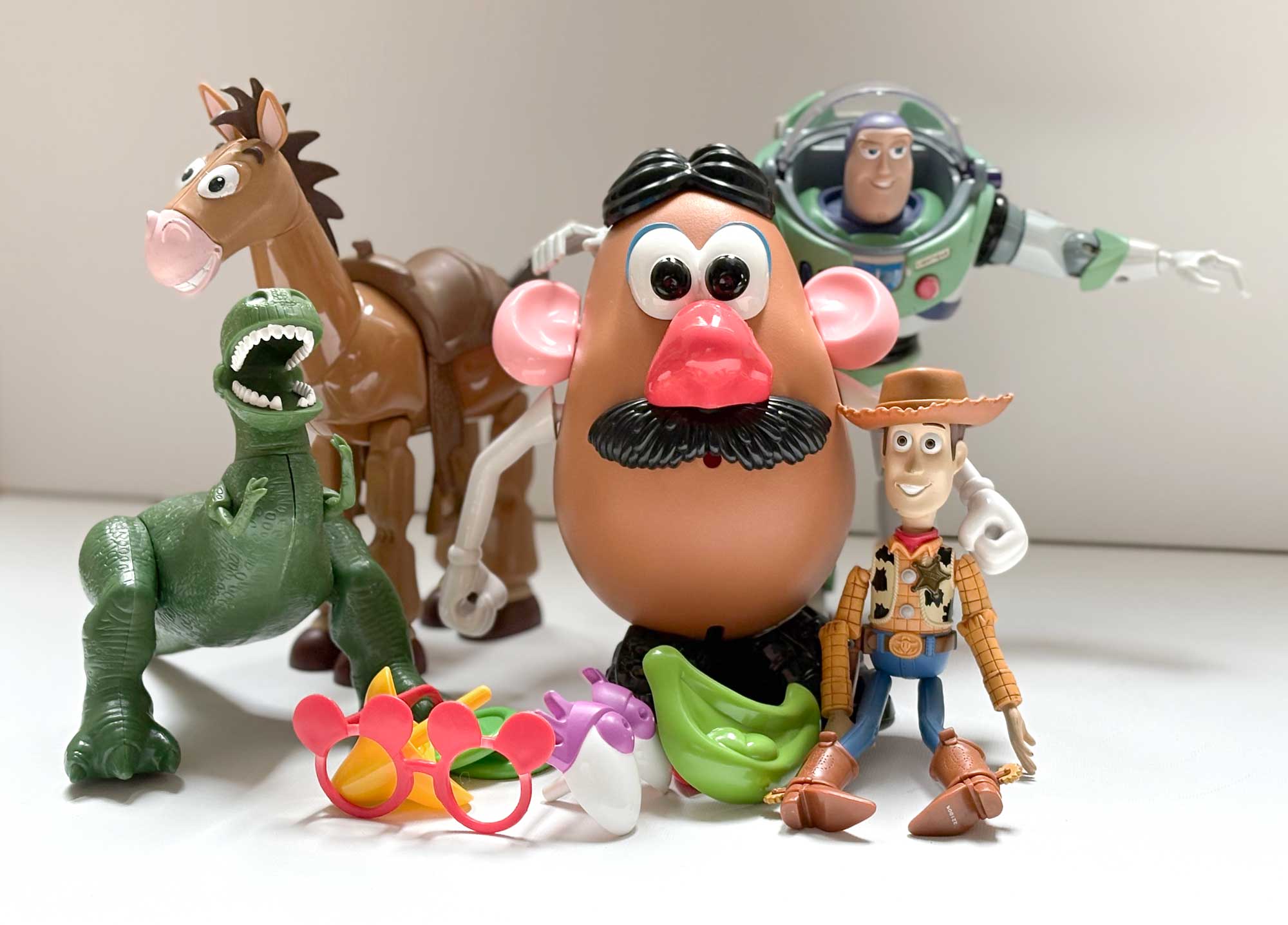
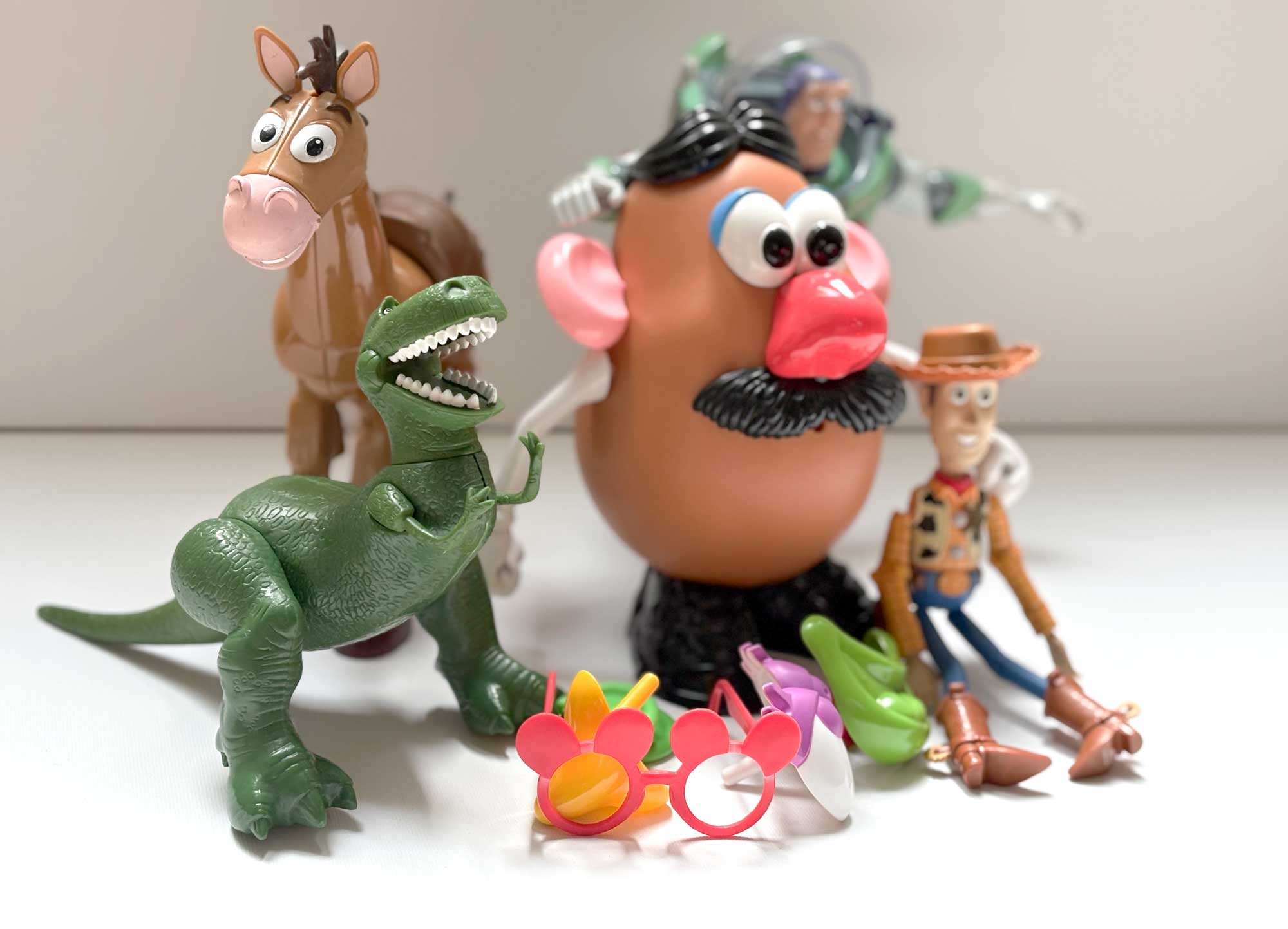
Toy Story itself existed because another unlikely bet had been running for almost a decade. In 1986, shortly after leaving Apple, Steve Jobs bought George Lucas's computer graphics group and turned it into an independent company called Pixar.
For years it struggled to find a business. Pixar sold expensive graphics computers. It developed rendering software. It made commercials. And in between, a small group led creatively by John Lasseter kept making increasingly ambitious animated shorts. Jobs kept funding it.
Disney and Pixar agreed to make one together in 1991. That film became Toy Story. Jobs did not create Woody or Buzz, but he gave the people who did the time, the money and the company they needed to prove that computer animation could carry a whole movie.
When Toy Story opened on 22 November 1995, Pixar was still a relatively small technology company attempting something nobody had done. A week later, Jobs took it public, in the biggest flotation of the year. The experiment was over. Pixar was a film studio. And Thinkway had the toys.
There was one particularly important instruction from Pixar. Buzz Lightyear was not to become a conventional action figure.
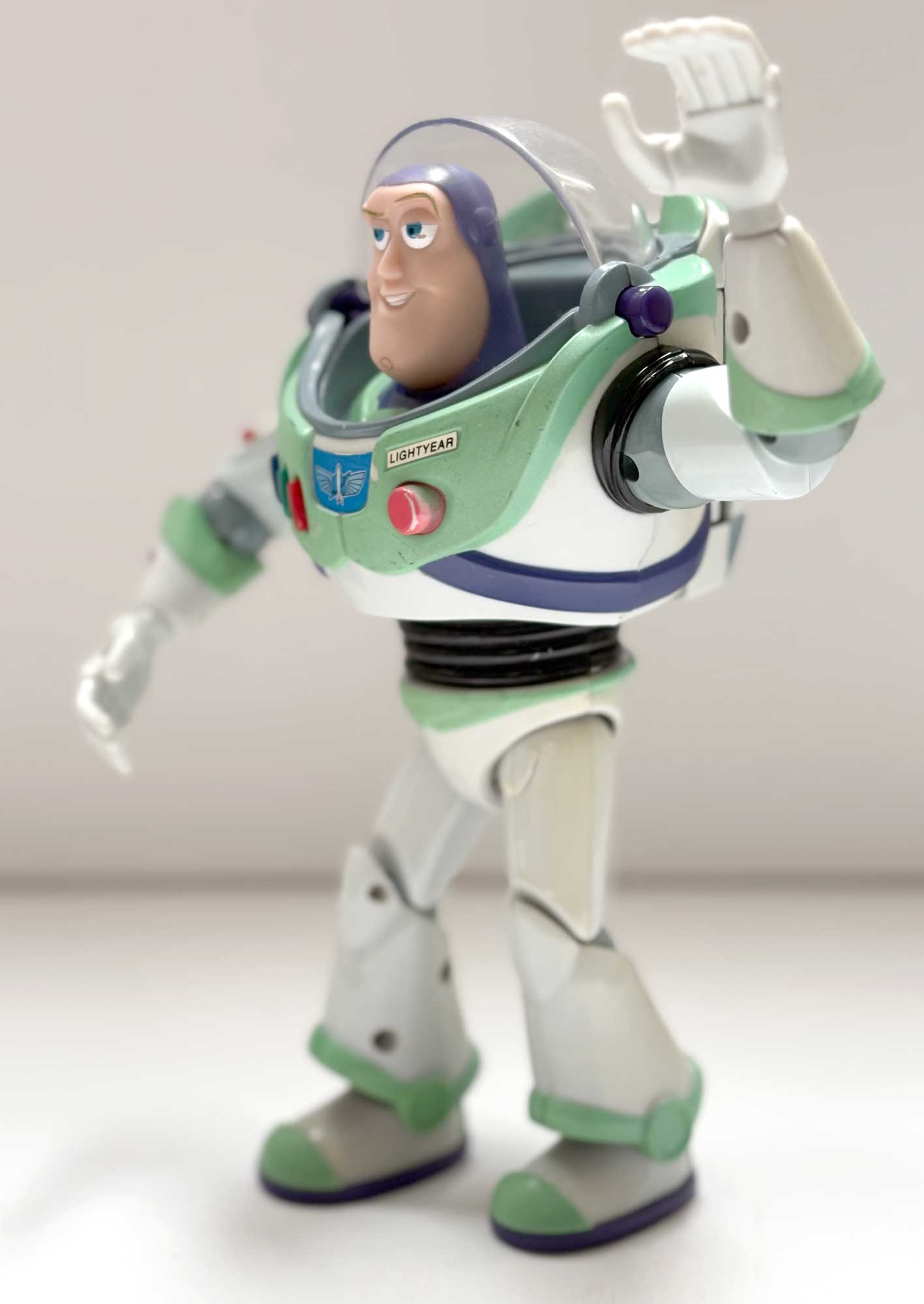
In the film, Buzz believes he is a real 12-inch toy. John Lasseter wanted the toy in the shops to be 12 inches too, rather than shrunk to the five-and-a-half-inch action-figure format standard at the time. That was unusually large, and Albert Chan initially questioned whether parents would pay the higher price. Pixar insisted. Thinkway trusted them.
The result was the Ultimate Talking Buzz Lightyear: twelve inches tall, with pop-out wings, lights, electronics and phrases from the film. Beside him stood a fifteen-inch pull-string Woody.
For a child leaving the cinema, something remarkable had happened. The toys existed at almost exactly the scale they had just seen on screen. They did not look like merchandise based on Toy Story. They looked like Woody and Buzz had climbed out of it.
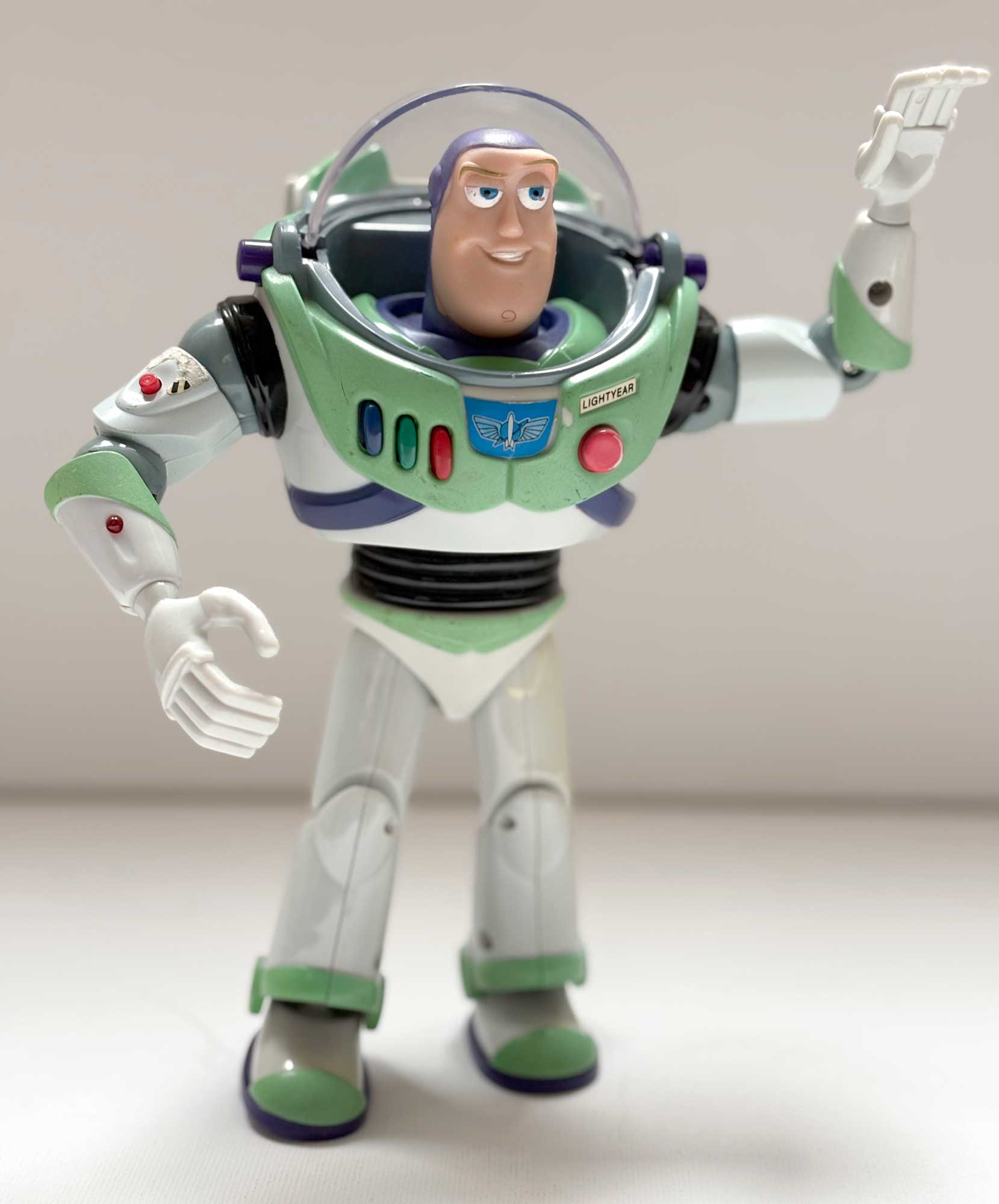
Toy Story opened at number one in America on 22 November 1995 and demand for the toys exploded. Thinkway went from being the small company willing to take a risky licence to trying to supply one of the hottest properties in the world. By that December it was selling Woody and Buzz figures in the millions, and retailers were still running out.
Buzz became particularly difficult to find. Shops sold out, parents searched from one to the next, and production could not catch demand. Thinkway had the problem every toy company dreams of and dreads at the same time: everyone wanted what it had made, and there were not enough of them.
The shortage became famous enough that Pixar turned it into a joke. In Toy Story 2, Barbie guides the toys through Al's Toy Barn past an aisle overflowing with Buzz Lightyears. The joke is that the retailers finally have plenty, a few years too late.
Twenty-six years with the biggest licence in animation, won in a month and held for a quarter of a century.
The spots for the toy nobody could keep in stock. They play inline here; the title opens the clip on YouTube.
Our own reading of the toys, checked against the public record. Follow these if you want to go further than we did.
The monsters that stomped across late-night Japanese television, cast in soft vinyl and painted by hand. Three Tokyo houses turned the Showa-era kaiju boom into toys, and barely sent one abroad. Today they are among the most coveted objects in collecting.
In 1966 Japanese television was overrun by monsters. Tsuburaya Productions' Ultra Q, and then Ultraman, had launched the tokusatsu boom, and every child wanted the beasts they saw on screen. A Tokyo company called Marusan answered with something new: a Godzilla standing upright, cast in soft vinyl, bright and light and cheap enough to end up in every toy box. It was the first kaiju soft-vinyl figure, and it started a genre.
The method gave each one its character. Liquid vinyl was poured into a heated metal mold, slushed around to coat the inside, then pulled out by hand and cooled. Every figure was sprayed by hand, so no two came out exactly alike. Marusan had invented sofubi, the soft-vinyl monster, and for a moment it owned the shelves.

Marusan's triumph was brief. Within two years the toy operation had collapsed into bankruptcy. But the story didn't end there: in 1969 its former staff regrouped as Bullmark, inherited many of Marusan's molds, and carried the genre into its golden age. Through the early 1970s Bullmark was the name in kaiju vinyl, Godzilla, Ultraman's rogues, Kamen Rider's villains, until the 1977 oil crisis took it under too.
The third house took a different road. Popy, founded in 1971 as an arm of Bandai, made its own kaiju but poured its real energy into die-cast: the Chogokin super-robots, starting with Mazinger Z. That heavy metal line became the foundation of Bandai's toy empire and the ancestor of the collectibles Bandai still sells today. Of the three houses, the one that survived was the one that changed the material. These were domestic toys, barely exported, which is exactly why a hand-sprayed Bullmark in a rare colorway now sells for the price of a car.

The short version of a long story: how the monsters of Japanese television became the grails of a global hobby.
Kaiju was never one company. It was a lineage of Tokyo houses, each picking up where the last left off.
The pioneer. Cast the first Godzilla in soft vinyl and invented the genre, then went under within two years.
Marusan's heir. Inherited the molds and ruled the golden age of kaiju vinyl until the oil crisis.
Bandai's arm. Made kaiju but bet on die-cast Chogokin robots, the line that became Bandai's empire.
Original 1970s toy commercials from the kaiju houses are scarce. This is the closest that survives: one genuine Popy TV spot, plus a look at the vintage pieces themselves and the Bullmark story. They play inline here; the title opens the clip on YouTube.
Our own reading of the toys, checked against the public record. Follow these if you want to go further than we did.
The company that proved a toy did not need a television commercial, a giant box or a place on the Christmas list to become unforgettable. Imperial specialised in the little things: bouncing balls, bubbles, rubber creatures, monsters and wonderfully strange novelties that children could actually afford. And behind it was Fred Kort, a man who had lost much of his own childhood in wartime Europe and went on to spend his adult life making toys for other people's.
Fred Kort arrived in the United States in 1947 with almost nothing. Born in Germany in 1923, he had survived persecution, forced labour and imprisonment at Treblinka during the Holocaust. After the war he trained and worked as an electrician, eventually moving to California. A chance repair job at Los Angeles' Biltmore Hotel introduced him to a guest working in the toy industry. Kort took a job with him and learned the business.
Twenty years later, he was ready to build something of his own.
In 1969 Kort and the young salesman Arnie Rubin founded Imperial Toy in Los Angeles. Their first hit was gloriously simple: a small high-bounce ball. It sold for around ten cents. Then came bubbles, rubber animals and the inexpensive rack toys that would become Imperial's speciality.
Kort later wondered whether his attraction to toys was connected to the childhood he had lost. If so, Imperial became quite a way of getting it back.
The little Los Angeles company grew into an international toy business producing hundreds of different products and selling in more than eighty countries. At its height, thousands of people worked for Imperial. Kort also used his success far beyond the toy industry, supporting Holocaust remembrance, humanitarian organisations, universities and medical institutions, and becoming one of the founders of the United States Holocaust Memorial Museum.
His life had begun in one world. Imperial was the world he chose to build afterward.
Imperial understood something the major toy companies often overlooked. Not every toy needed to be an event. Some toys simply needed to be there.
Imperial lived on supermarket hooks, drugstore racks and displays near the checkout. Its toys were inexpensive, immediate and wonderfully difficult for a child to ignore. In the company's earliest years, virtually nothing cost more than a dollar.
That philosophy produced one of the strangest catalogues in American toy history. There was the Hungry Mouse in the Cheese House. The Silly Dilly Sky Diving Poopatroopers. Marvel Super Hero finger puppets. Buck Rogers Space Marbles. Jaws. Close Encounters of the Third Kind. James Bond. Hanna-Barbera characters. Bubbles in almost every imaginable form.
Imperial did not make toys feel precious. It made them accessible.
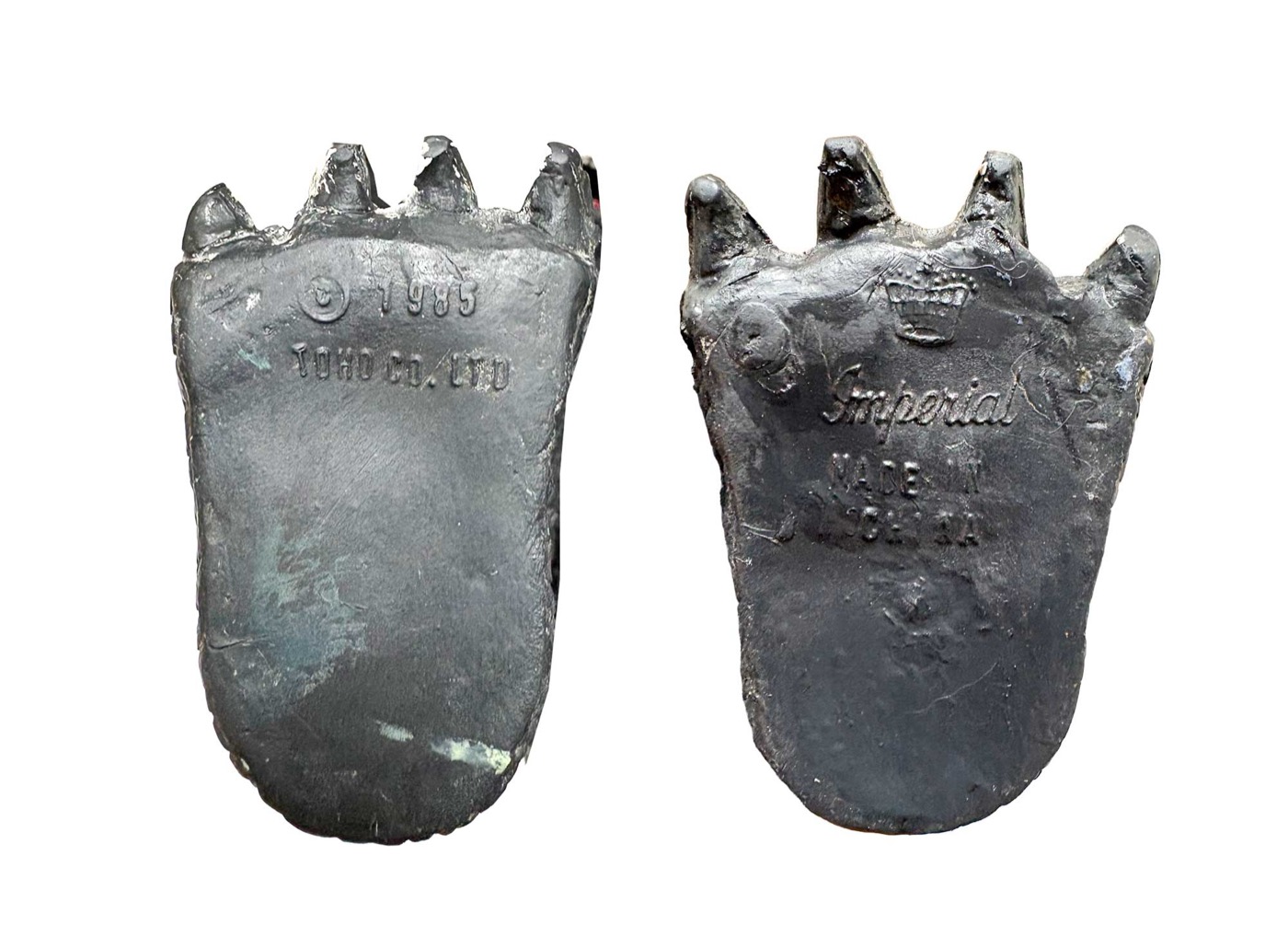
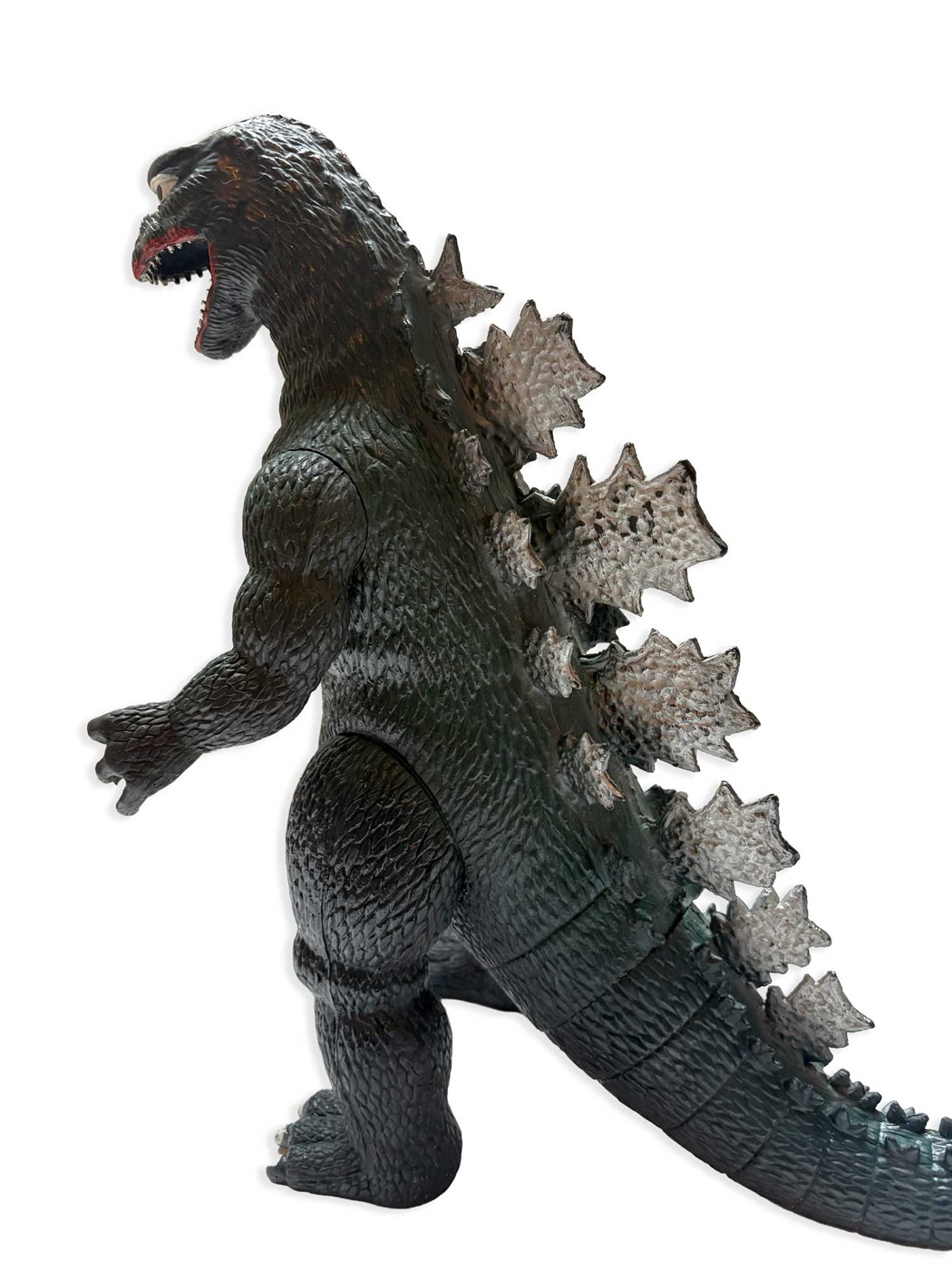
And then came the monsters. In 1985, alongside the American release of Godzilla 1985, Imperial produced its own licensed Godzilla range. The star was a wonderfully straightforward articulated vinyl Godzilla, available in several sizes and accompanied by the kind of bubble toys, bop bags and novelty products Imperial knew how to sell better than almost anyone. A year later came King Kong.
For collectors today, Japanese makers such as Marusan and Bullmark represent the exotic, beautifully made kaiju toys people dream of finding. Imperial represents something different. It made the monster you could actually take home.
Its Godzilla did not have to be imported from Tokyo or discovered decades later in a collector's cabinet. It could be hanging in an American drugstore, supermarket or toy shop, waiting for a child with a few dollars in their pocket. That accessibility is exactly why Imperial matters.
Thousands upon thousands of those Godzillas were bought, carried around, fought against other toys, left in gardens, thrown into toy boxes and loved until their paint disappeared. They were not made to become museum pieces. They became them anyway.
From a ten-cent bouncing ball to two of the biggest monsters in cinema.
Hundreds of products, almost none of them expensive. These are the ones collectors come looking for.
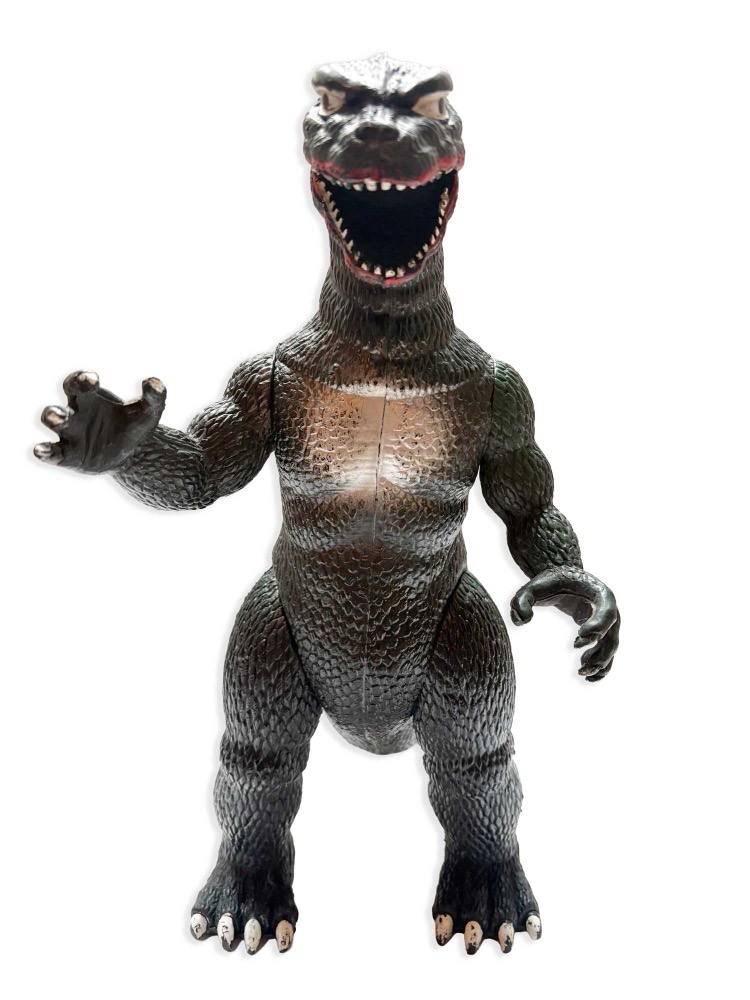
Articulated vinyl in several sizes, for the American release of Godzilla 1985. The Godzilla most American children actually owned.
The follow-up to Godzilla. Large, soft and built to be dragged round a garden rather than kept in a box.
The actual business. A ten-cent bouncing ball first, then bubbles in every imaginable form and rubber animals by the crate, on hooks by the till.
Jaws, Close Encounters of the Third Kind, Marvel Super Hero finger puppets, Buck Rogers Space Marbles, James Bond, Hanna-Barbera.
No original Imperial television spot has surfaced, so these are collectors' showcases rather than period advertising. They are here because they show the thing itself: the vinyl, the joints, the paint, and the size in a hand.
Our own reading of the toys, checked against the public record. Follow these if you want to go further than we did.
The most coveted Star Wars playset in the world is made of cardboard. Not because anyone wanted it that way: Palitoy could not afford the plastic. That decision, taken in a Leicestershire factory in 1978, is why a British company most collectors outside the UK had never heard of now sits near the top of the list.
Alfred Edward Pallett founded the Cascelloid company in 1919, working in celluloid: combs, rattles, small moulded things. The toy side needed a name of its own, and the one he registered was his own surname with the job attached. Pallett, plus toy. Palitoy. It is printed on the back of every British Star Wars card and almost nobody reads it as what it is.
For decades the toys were a division rather than a company. Then in 1965 the toy operation at Coalville was separated out and given the Palitoy name properly, and in 1968 the parent company sold it to General Mills, the American food giant that had been quietly buying toymakers.
General Mills already owned Kenner and Parker Brothers. So when Kenner took the Star Wars licence in 1977 and could not make figures fast enough for the world, the British arm of the same parent company was the obvious place to send it. Palitoy did not win Star Wars in a bidding war. It inherited it through a corporate structure.
In 1966 Palitoy licensed Hasbro's G.I. Joe and rebuilt him for Britain as Action Man. What arrived was not a straight copy. Over the following years he collected the details British children actually remember: the flocked hair, the gripping hands, and the eagle eyes you moved with a lever in the back of his head.
By the late 1970s more than twenty million had been sold. Whatever else Palitoy did, this was the thing it did biggest, and it is worth holding onto when the Star Wars story takes over: the company that made the cardboard Death Star was, first and for longer, the company that made Action Man.
Kenner's Death Star Space Station was injection-moulded plastic, three storeys of it, and it was expensive to make. Palitoy costed the same toy for the British market and the numbers did not work: the tooling and the material were beyond what the division could spend on one playset.
So it was redrawn in printed cardboard. Same idea, same gun turret and lift and trash compactor, built out of card and a few plastic parts instead of a moulded shell. It went out cheap in 1978 and it was never sold anywhere but Britain.
Which is exactly why it is now the prize. Cardboard does not forgive damp lofts, sticky tape or children, so the ones that lasted are rare in a way an injection-moulded playset never is. Complete boxed examples in serious condition trade for thousands. The cheap version outlived the expensive one, and the compromise became the most wanted thing the company ever made.
The design department at Coalville closed in August 1984. On the first of May 1985 most of the work stopped: of 585 people in manufacturing and distribution, 327 were made redundant. What was left of Mainline Railways went to Dapol in South Wales the same year. In 1986 the Palitoy name stopped trading.
The building did not close with it. General Mills sold its toy business, and the Coalville site carried on under Kenner Parker, staffed in part by the same people, making toys for the company whose figures Palitoy had been licensed to produce. Tonka bought Kenner Parker in 1987 for $555 million. Hasbro closed the site in 1994.
In 2017 Leicestershire County Council put a green plaque on the business park that stands there now, for a company that, in its own words, helped stoke children's imaginations. It is the only thing on the site that says what used to be made there.
From celluloid combs to the British Star Wars line, and the slow handover to the company that had licensed it.
What came out of Coalville, from the one that sold twenty million to the one made of card.
G.I. Joe rebuilt for Britain, and the biggest thing the company ever sold. Twenty million by the late '70s.
The British line, on British cards, including the cardboard Death Star that was never sold anywhere else.
The small fashion doll, built at a scale that fitted a pocket rather than a shelf.
The model railway range. What was left of it was sold to Dapol as the factory wound down.
British spots, not the American ones. Every clip here was checked against its thumbnail before it went in, because a dead video id renders as a broken tile. They play inline; the title opens the clip on YouTube.
Our own reading of the toys, checked against the public record. Follow these if you want to go further than we did.
Every other maker on this site left a paper trail: founders, addresses, lawsuits, an obituary. Dor Mei left toys. No founding date anyone agrees on, no factory address, no company history, not one interview. What survives is the moulding itself, stamped into the soles of monsters that were never licensed to exist. It turns out to be enough: the one encyclopaedia that mentions this company dates its figures a decade wrong, and the stamp on the foot is what proves it. This is what the record looks like when nobody bothered to keep it, and what a toy can still tell you anyway.
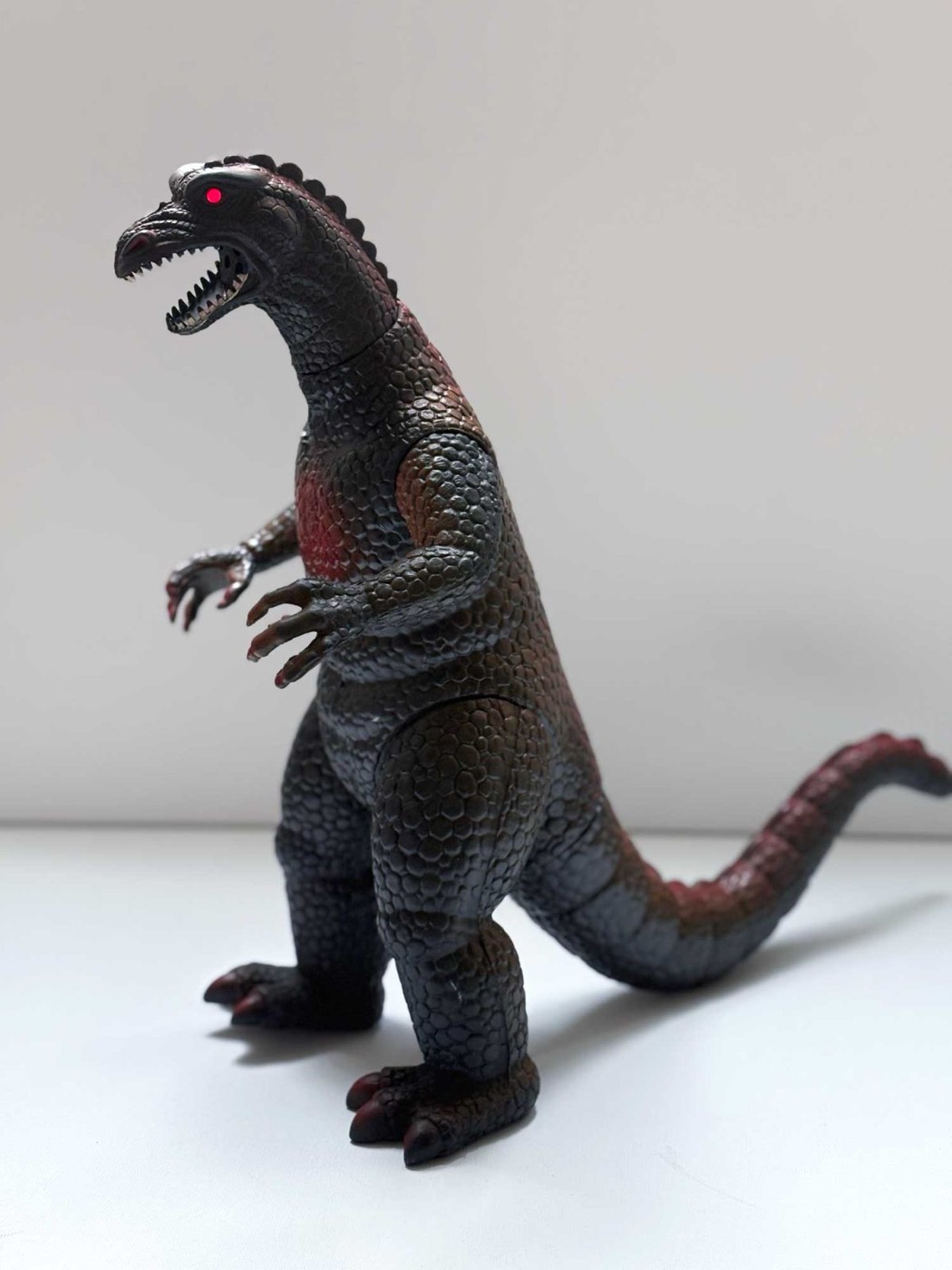
There is no origin story here, and pretending otherwise would be the easiest lie on this website. Dor Mei was a Hong Kong toymaker that cast large vinyl monsters in the shape of Godzilla without ever holding the right to do so. Who founded it, when it opened, how many people worked there, whether it made anything else at all: none of that is written down anywhere we can find.
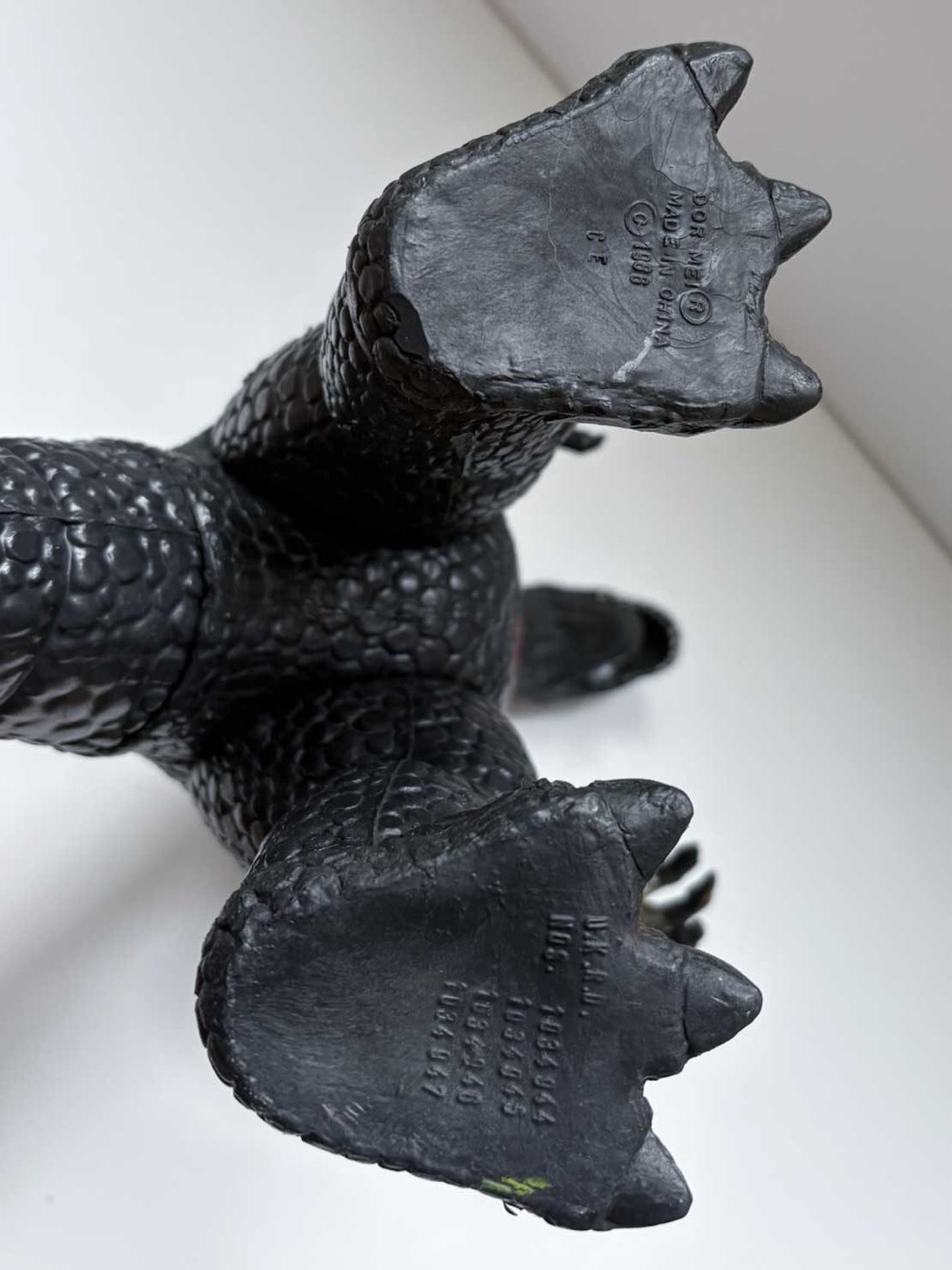
What can be established is what the toys themselves say. The soles carry DOR MEI, a registered-trademark symbol, a country of origin and a copyright year. That is the entire archive.
That stamp is doing more work than it looks. It is the reason this page can date the figures at all, and the reason it can contradict the only encyclopaedia that mentions them. A licensed toy is documented by the licence: Toho knew exactly who was making Godzilla and on what terms, and that paperwork is why the Bandai and Marusan histories can be written at all. An unlicensed one is documented by nobody, because the whole point was not to be. The absence of a record is not an oversight. It is the business model.
The only reference work that covers Dor Mei at all puts these figures a decade later than they belong. We can say that with some confidence, because the answer is pressed into the bottom of the foot.
| Source | Says | Worth |
|---|---|---|
| Wikizilla, the kaiju encyclopaedia | “In the late 1990s, Dor Mei produced several unlicensed Godzilla figures” | The only encyclopaedic entry that exists. It is also the only source that says this, and it is out by roughly ten years. |
| The market, across eBay, Etsy and Worthpoint | 1986, near-unanimously | Hundreds of listings agree. On its own that proves little: sellers copy each other's dates. |
| The sole of our own figure | DOR MEI ® · MADE IN CHINA · © 1986 | Pressed into the tool at the factory. This is the one that settles it. |
Three things separate a Dor Mei from the licensed figures it was pretending to be, and from the other Hong Kong casts of the same era.
Everything this page claims about the date comes off these two feet. They are not stock images: this is the example we handled, and it is why the page can disagree with the reference work.
The obvious objection: this is a knock-off, so why give it a page next to Kenner and Palitoy?
Because it stopped being a knock-off some time ago. A fake works by being mistaken for the real thing, and nobody buying a finless Dor Mei is under any illusion about what it is. It is collected as itself: a specific object, from a specific factory, that a generation of children in Europe and America actually owned, because it was on the market stall and the licensed Bandai figure was not.
It is also, quietly, the more honest half of the history. The licensed toys tell you what Toho approved. The bootlegs tell you what the demand was so large that it got met anyway, by whoever had a vinyl press and no lawyer. Both are the record of what happened.
What we will not do is describe one as licensed. Every Dor Mei lot on this site says unlicensed, in the description, in as many words. That is the line: the toy is legitimate to sell and collect, and pretending it came from Toho is not.
Thin, and deliberately shown as thin. There is one reference entry and a market; the rest of this page is read off the toy.
A private collection that grew into something bigger. This is where it comes from, and what we hunt for.
What began as a handful of childhood pieces turned into a hunt: for the odd, the overlooked and the wonderfully strange. The finding, the careful cleaning, the search for a missing weapon or a lost accessory, the stories behind each toy. Somewhere along the way the collecting became a way of living.
We are drawn to the weird ones. Toys that were played with, loved and actually handled, over the pristine pieces sealed and graded never to be opened again. A toy locked in plastic, never to be read or felt, becomes a frozen artifact. We would rather keep them alive.
Have a collection of your own? We buy and take on whole collections and single pieces. Tell us what you have, send a few photos, and we will look after it.
Add a few clear photos. Our AI identifies the toy, dates it, grades the condition and builds the listing for you. It also checks recent sales to suggest a fair starting price.
Identification is free. You only use a listing when you decide to sell.
Add front, back, accessories and any visible flaws. Include one close-up of the moulded maker's stamp so we can date and identify the toy accurately.
A worn or partly legible stamp is fine.
Our AI identifies the toy, year, line and variant, then grades its condition and checks recent sales to suggest a price.
You can review the details and sources before listing.
Edit any detail, correct the variant, set your Reserve or Buy Now price, then approve the listing.
Your lot first appears in Preview so buyers can watch it. When the auction opens, bidding begins.
After the sale, we share the buyer's shipping details and they can leave a review.
Toy identification is free and unlimited. Photograph anything and we will identify it, date it, show what originally came with it and grade its condition. You only pay when you list. Choose a package based on how much you sell, or let us work out which one costs you least.
You do not have to run an auction to get rid of a box of toys. Send us photographs, we tell you what it is worth, and we make you an offer for the lot. You post one parcel and we pay. No listing, no waiting, no wondering whether it sells.
We would rather you picked the right one than the one that suits us, so here is the arithmetic on a toy we think will fetch €30.
| On a toy worth about €30 | Sell it to us | Sell it through us |
|---|---|---|
| You receive | € 15,00 | € 25,50 |
| When | Within a week | After it sells |
| If it does not sell | Our problem | You still have it |
| Photographs, listing, packing | We do it | You do it |
| If it turns out to be rare | We keep the upside | You keep it |
The honest reason: assessing one toy and assessing forty costs us nearly the same in setup, so a whole collection is worth far more of our attention than a single common figure.
1. You send photographs. A few clear shots of what you have, laid out. For anything you think is worth something, add a close-up of the moulded stamp on the feet or the lower back: that text is what lets us date it and find what it really sells for.
2. We tell you what it is, before we make an offer. You get the identification either way, and you keep it whether you sell to us or not. If we think a piece is worth more than we would pay for it, we will say so and tell you to list it yourself.
3. We make one offer for the lot. Within two working days, with the reasoning attached: what we think each piece fetches and what we are paying for it. No haggling and no fishing.
4. You post it, we pay. We send you a prepaid label. Payment goes out the day the parcel arrives and matches the photographs. If something is not as described you get the parcel back at our cost, not a lower offer.
Photographs and a way to reach you. Nothing else needed, and nothing is committed by sending it.
Toy identification is always free and unlimited. Photograph anything and we will tell you what it is, who made it, when it was made and what condition it is in. You only pay when you sell. Choose a package based on how much you sell each month. Every package includes price research, buyer protection and live postage rates.
Tell us roughly how much you sell. We will compare the monthly fee and selling fee together and recommend the cheapest package.
Compare what buyer and seller pay together. On a €100 hammer price, Catawiki charges the seller 12.5% and adds another 9% buyer fee. The buyer pays €109 while the seller receives €87,50. Hammer & Mold adds no buyer fee. A €100 hammer price means the buyer pays €100.
| On a €100 hammer price | Buyer pays | Seller receives | Total platform fees |
|---|---|---|---|
| Catawiki | € 109,00 | € 87,50 | 21,5% |
| Hammer & Mold, Starter | € 100,00 | € 85,00 | 15,0% |
| Hammer & Mold, Trader | € 100,00 | € 88,00 | 12,0% |
| Hammer & Mold, Dealer | € 100,00 | € 92,00 | 8,0% |
A monthly package fee buys you a lower selling fee. Sell enough in a month and the saving becomes greater than the subscription. Sell less, and Starter is cheaper. The table shows the total cost of each package at different monthly sales volumes.
Live lots from this seller.
Controller: RG Product Design, Netherlands. KvK 96149302. Privacy contact: privacy@hammerandmold.com. Last updated 26 August 2026.
This policy explains what personal data Hammer & Mold collects, why, who it is shared with, how long it is kept and what rights you have. It covers hammerandmold.com and the accounts, listings, bidding and payment features on it.
We collect the minimum needed to run an auction house: your email to sign you in, what you list, what you bid, what you buy, and a delivery address when something sells. We run no advertising trackers and set no tracking cookies. We do measure how the site is used, with a counter that sets no cookie and stores nothing that identifies you: it tells us which pages get read and roughly where visitors came from, and nothing about you as a person. We do not sell or rent personal data, ever. We do not profile you for advertising.
Account and identity. Your email address, and the display name, handle, seller type, location and bio you choose to add.
Membership and balances. Your plan, listing-token balance, notification preferences, and the customer and subscription identifiers our payment provider gives us. We never see or store your card details.
Listings. The photographs you upload and the description, condition, variant and price data attached to them.
Activity. Bids you place, lots you win or sell, lots you add to your watchlist, and reviews you write or receive.
Delivery. When you buy, our payment provider collects your name, delivery address, phone number and email and passes them to us so the Seller can ship. A tracking number if one is added.
Messages. If you message a Seller, we process the message text and your email address so they can reply. Neither party's address is shown publicly.
Technical. Our host, content networks and providers log IP addresses and request data to serve the site and keep it secure. Your browser stores a sign-in token, your theme choice and any unsent listing draft locally on your own device.
To perform our contract with you (Art. 6(1)(b) GDPR): creating and running your account, publishing your listings, registering bids, taking payment, sharing a delivery address so a sale can be fulfilled, and running a paid membership.
Our legitimate interests (Art. 6(1)(f)): preventing fraud, shill bidding and abuse; moderating what is listed; keeping the Platform secure; emailing you about your own activity, such as being outbid, winning, selling, or a watched lot ending soon; and establishing or defending legal claims. You can turn the activity emails off in your account at any time.
Legal obligation (Art. 6(1)(c)): keeping transaction and invoice records for tax and accounting.
Consent (Art. 6(1)(a)): announcements and any future marketing email. You can withdraw consent at any time without affecting anything done before.
When you upload photographs to list an item, the images are sent to an AI provider which identifies the toy, dates it, grades its condition, drafts the description and proposes a starting price. The same step screens for items that may not be listed. This is automated, it is not guaranteed to be correct, and you review and confirm every listing before it goes live.
To price the lot, a second automated step then searches the public web for recent sales of the same toy. The search terms describe the object only, for example its maker, year and moulded markings. Your photographs are not published, and no information about you as a person is included in a search.
An automated screen can refuse a listing. That decision is not final: a person will review it if you ask us to, and you can reach us at the privacy contact above or through your account. We do not use automated decision-making to profile you or to set prices individually.
We use the following processors and services. Each receives only what it needs.
Supabase · database, sign-in and photo storage. Hosting region: West EU, Ireland (eu-west-1), so your data stays inside the EU.
Cloudflare · the functions that handle payments, notifications, AI curation and the message relay, and the visitor counter described in section 1. The counter sets no cookie and records no identifier; it sees your IP address in order to answer the request, as any web request does, and does not keep it. European Union and United States.
Anthropic · the AI that reads your listing photographs and searches the web for comparable sales. United States.
Stripe · payments, membership billing, and collecting the delivery address. Ireland and United States.
Resend · sending our email. European Union (Ireland).
GitHub Pages · hosting the website itself. United States.
jsDelivr · delivering one software library the site needs.
Google (YouTube) · the archive commercial thumbnails on our maker pages load from YouTube's image servers, so your IP address reaches Google when you view those pages. Clicking one opens YouTube, where Google's own privacy policy applies.
We also share a Buyer's delivery details with the relevant Seller, for fulfilment only. We disclose data to authorities where the law requires it. If the business is ever sold or restructured, data may transfer with it, and we will tell you first.
Some providers above are in, or process data in, the United States. Those transfers rely on the European Commission's Standard Contractual Clauses, on an adequacy decision such as the EU-US Data Privacy Framework where the provider participates, or on another lawful mechanism, together with the provider's own safeguards. You can ask us which mechanism applies to a specific provider.
Your seller page shows your display name, handle, seller type, location, bio, the date you joined, your listings and any reviews you have received. Your email address, plan, token balance, notification settings and delivery address are never published. Bids are shown as amounts and a count, not as bidder names. A review you write is published with your display name.
Account and profile data: while your account is open, then deleted or anonymised within 90 days of closure.
Transaction, invoice and commission records: seven years, as Dutch tax law requires.
Listings and photographs: while listed, and afterwards in the sold archive as a price record.
Bids: kept with the lot, so a completed auction stays auditable.
Messages: 24 months. Reviews: while the profile they concern exists.
Server and security logs: 90 days, per each provider's own retention.
We set no advertising or tracking cookies, and we have no consent banner because we have nothing to ask consent for. That includes our visitor counter: it works without a cookie and without a persistent identifier, which is the reason it needs no consent and the reason we chose it. What we do use is strictly necessary: a sign-in token so you stay logged in, your light or dark theme choice, an unsent listing draft, and an offline cache so the site loads. All of it sits in your own browser and you can clear it at any time. Third-party requests described in section 5 will see your IP address, as any web request does.
You can ask us to give you a copy of your data, correct it, delete it, restrict or object to how we use it, or hand it to you in a portable form. You can withdraw consent where we relied on it, and turn off activity emails yourself in your account. Some data we must keep regardless, such as invoices within the seven-year tax period.
Write to the privacy contact above. We answer within one month. If you are unhappy with our answer, you may complain to the Dutch data protection authority, the Autoriteit Persoonsgegevens (autoriteitpersoonsgegevens.nl), or to the authority where you live.
Access to the database is restricted per record, so signed-in users reach only their own data. Payment card details never touch our systems. Administrative functions are limited to admin accounts. No system is perfectly secure; if a breach is likely to put your rights at risk we will notify the Autoriteit Persoonsgegevens within 72 hours and tell you where the law requires it.
The Platform is for people aged 18 and over. We do not knowingly collect data from children. If you believe a child has registered, tell us and we will delete the account.
We may update this policy. The date at the top always shows the current version, and we will tell you about a significant change before it takes effect.
RG Product Design · KvK 96149302 · hammerandmold.com · privacy@hammerandmold.com
Draft v0.1 for review. Complete the [bracketed] fields and have a qualified adviser review before publishing. See also our Terms & Conditions.
Shipping and customs do not follow the same map, which is where most people go wrong. Europe is not the EU. The UK, Switzerland and Norway are geographically European but outside the EU customs union, so purchases from them may still be imports. For shipping, we use four zones:
These figures estimate shipping from the Netherlands and shipping into the Netherlands. Domestic prices use PostNL rates. International prices are estimates because the carrier depends on the seller's location.
| Weight | Within NL | NL → EU | NL → UK / non-EU Europe | NL → rest of world | EU → NL | Outside EU → NL |
|---|
Simple. There is no import duty or import VAT to pay on arrival.
€50 item + €12 shipping = €62 total
This is where a bargain stops being one. Extra costs can be added to the item price and shipping:
item + shipping + VAT + duty + handling = landed cost. A €100 Godzilla from Japan with €23 shipping can end up costing closer to €155 than €123.
Your buyer pays the item price and shipping together at checkout.
Buyers outside the EU may also be charged import VAT, customs duty or handling fees by their own country when the parcel arrives. Those costs are paid by the buyer and are not included in Hammer & Mold's shipping price.
Business sellers may have different VAT rules. Check with your accountant if this applies to you.
Choose where the parcel is going, its zone and weight. If you're buying, we estimate the total landed cost. If you're selling, we estimate the shipping price to enter on the lot.
Operator: RG Product Design, Netherlands. KvK 96149302, VAT NL005191127B77. Registered address on request at support@hammerandmold.com. Last updated 26 August 2026.
By creating an account, listing an item, bidding or buying, you agree to these Terms. If you do not agree, do not use the Platform. We may update these Terms; continued use means you accept the revised version.
For consigned lots, Hammer & Mold is an intermediary connecting Sellers and Buyers; the sale contract is between them, not with us. For lots we own and sell ourselves this is clearly marked. We do not take custody of or independently verify consigned items unless stated.
You register with a valid email and are responsible for activity on your account. One account per person or business. You must be 18 or older. We may suspend accounts that breach these Terms.
Listings are prepared with AI-assisted curation and this is not guaranteed to be accurate. The Seller is solely responsible for reviewing and confirming every listing (identification, variant, condition, completeness, authenticity) before it goes live. Only genuine collectible toys, models and related memorabilia may be listed; items that are not collectibles, or that are prohibited (including adult, sexual, weapon or illegal content) are refused automatically, and we may edit, refuse or remove any listing at our discretion. Each published listing uses one listing token from the Seller's balance.
Suggested starting bids, estimate ranges and any comparable sales shown to the Seller are indicative market research, not a valuation, an appraisal or a guarantee of value. Comparable listings are third-party data collected automatically from public sources: they may be inaccurate, out of date, mis-converted between currencies or not genuinely comparable to the lot. The Seller sets the final price and is responsible for it. Nothing in a curation is investment or resale advice.
A placed bid is a binding, irrevocable offer, subject to any hidden reserve. The highest valid bid at close, or acceptance of a Buy-now price, wins. We may extend, void or re-open an auction in case of a fault, error or suspected manipulation.
Payments are handled by our provider (Stripe); by transacting you accept their terms. The Platform deducts a seller commission on the total the Buyer pays, postage included, at the rate of the package you are on, plus applicable fees. We charge on the total because the total is what we process; postage is passed to the carrier at the price quoted and is not a margin.
When you are paid. Your share of a completed sale is credited to your seller balance once the sale completes and, where applicable, once the Buyer has received the item. We pay out on the same date every month, whenever your balance is €25 or more. A balance below that rolls into the following month, and we pay it out regardless of size at least once every three months, so nothing sits with us indefinitely. Your balance and the date of your next payout are shown in your account.
The minimum exists because every payout carries a fixed cost from our payment provider. Sending €4 would spend a large part of what you earned on the transfer itself, which is worse for you than waiting a few weeks. It is not a way of holding your money: the three-month rule pays the full balance whatever it comes to, and you can ask us to release a balance at any time at no charge, for example if you are closing your account.
Listing uses tokens. Identifying a toy is free and unlimited and spends no token; a token is used only when you list a lot. There are three packages. Starter is free and carries the standard commission. Trader and Dealer are paid monthly memberships with a larger listing allowance and a lower commission; Dealer also includes featured placement as set out in clause 7. The current price, allowance and commission of each package are shown on the packages page and in your account, and are the ones that apply.
Moving between packages. Moving up takes effect immediately and your card is charged only the difference for the remainder of the period, not a further full period. Moving down takes effect at the end of the period you have already paid for: until then you keep the package you bought, and you may cancel the change before it takes effect. Unused tokens remain yours and roll over up to twice your monthly allowance; moving down does not remove tokens you already hold, it only reduces what you are topped up to afterwards.
A membership renews automatically until cancelled; you may cancel at any time and keep access until the end of the paid period. Partial periods, tokens and token top-ups are non-refundable. Sellers handle their own tax and VAT. We are not a bank; funds are held and moved by the provider.
Featured placement is advertising. A featured lot is shown in a promoted strip above the shop grid, labelled as a paid promotion. It is included in the Premium membership: while your membership is active you may have one lot promoted at a time, for up to seven days per lot, subject to fair use and to available slots (currently eight). Placement may also be bought separately at the price quoted at the time.
Placement affects only where a lot is displayed. It does not change the lot, the reserve, the bidding, the commission or the outcome of a sale, and it gives no preference in any dispute. We do not guarantee views, bids, a sale or any particular result. We may refuse, reschedule or withdraw a placement, including where a lot is removed, breaches clause 4 or 13, or where the promoted strip is oversubscribed; if we withdraw a paid placement before it has run we refund the unused part. Once a placement has started, fees for it are otherwise non-refundable. Fees for placement are for an advertising service and are charged separately from seller commission.
How lots are ranked. In the shop, lots are ordered by the sort you choose (newest, ending soon, or price), and within the promoted strip by the order we set. Apart from the promoted strip, payment does not influence ranking: no plan, fee or membership moves a lot up the normal listings. The promoted strip is the only placement that can be paid for, and it is always labelled as such.
Every lot states its shipping cost, and the checkout total is what you pay. A lot either includes postage in its price or shows a shipping amount, which is added once at checkout as part of the same payment. We never add postage afterwards and never invoice it separately. We currently ship to the Netherlands and the EU only, tracked. If you are outside that area, contact us before bidding.
We quote the postage, not the Seller. At checkout we ask the Buyer for a delivery address and price the parcel live with the carrier for that country, using the lot's packed weight. The Buyer chooses the service: through the letterbox where the item fits, collection from a pickup point, or delivery to the door. A Seller cannot set or change that amount.
Commission is charged on the total the Buyer pays, postage included. We charge on the total because the total is what we process, and we say so here rather than in a footnote. Postage is not a margin: it is passed to the carrier at the price quoted.
The Seller packs and dispatches promptly after payment, using the service the Buyer paid for, and must send with a valid tracking code.
Risk in transit. Where you buy as a consumer, the risk of loss or damage in transit stays with us until you take physical possession of the item, as Dutch and EU consumer law requires. That risk is ours whether or not a carrier pays anything out, and it is not something we could disclaim to a consumer. If an item arrives damaged, tell us within 48 hours with photographs and keep the packaging: a carrier claim needs both, and we cannot pursue one afterwards without them. If an item does not arrive at all, you are refunded in full. Between businesses, risk passes on dispatch.
Returns and who pays the postage. Two different situations, and the difference decides who is out of pocket. If an item arrives materially different from its listing, damaged, or not as described, return it and you are refunded in full including what you paid for postage, and we cover the cost of sending it back. If you change your mind, you may return an item within 14 days of receiving it, but you pay the return postage yourself and the refund covers the item rather than the original delivery. Tell us before you send anything back so the return is recorded and reaches the right address. This is stated here in advance deliberately: a buyer who is not told beforehand that a change-of-mind return is at their own cost cannot be charged for it.
Vintage toys are second-hand collectables sold "as-is, with all faults". Descriptions and curation are opinions on a best-effort basis, not guarantees of authenticity, completeness, grade or value. Buyers should inspect photos and ask before bidding. Statutory consumer rights are not removed by this clause.
Where mandatory EU/Dutch consumer law applies, consumer Buyers keep their statutory rights, including the right of withdrawal and remedies for non-conforming goods.
Winning at auction does not take away your fourteen days. The exemption for public auctions covers sales a consumer can attend in person, and ours are online only, so it does not apply here. A consumer Buyer may return a lot within fourteen days of receiving it, whether it was won at auction or bought outright. Change of mind is at your own return postage; an item that is damaged or materially different from its listing is refunded in full, return postage included. Second-hand does not shorten any of this.
The Platform is provided "as available". We do not guarantee uninterrupted or error-free operation and may suspend or change it. To the maximum extent permitted by law, we are not liable for loss from downtime, delay, data loss, or missed or unregistered bids.
To the maximum extent permitted by law, we are not liable for indirect or consequential loss, or loss of profit, data or goodwill. Our total liability for any claim is limited to the greater of the commission we earned on the relevant transaction or [€100]. Nothing here limits liability that cannot be limited by law (e.g. death or personal injury by negligence, fraud, or mandatory consumer-law liability).
No counterfeit, stolen, unsafe-recalled or illegally-exported items, misrepresentation, shill bidding, fee circumvention, or unlawful use. We may remove listings, void sales and close accounts for breaches. You indemnify us against claims arising from your listings, sales, shipments or breaches.
After a completed purchase a Buyer may leave one review of the Seller. Reviews must be honest and based on a genuine transaction. No fake, incentivised, abusive, defamatory or unlawful reviews, and no reviewing your own listings. We may remove or withhold reviews that breach these rules, and reviews reflect the opinion of the Buyer, not of the Platform.
You keep ownership of your photos and text and grant us a license to host and display them for the Platform. To complete a sale, a Buyer's shipping details are shared with the relevant Seller for fulfilment only. Your public seller page shows your display name, handle, seller type, location, bio, the date you joined, your listings and any reviews you have received; your email address, plan, token balance and notification settings are not published. We process personal data per our Privacy Policy and the GDPR. These Terms are governed by the laws of the Netherlands, subject to any mandatory consumer protections in your own country.
RG Product Design · KvK 96149302 · hammerandmold.com · support@hammerandmold.com
Draft v0.2 for review. Complete the [bracketed] fields and have a qualified lawyer review before use.
Identifying a toy is free and unlimited on every package. A listing is what costs a token. Every package includes the price research, buyer protection on every lot, and postage quoted live from the carrier.