The Toy
Know what you're buying
Year, maker, series, scale, accessories and condition. The details collectors actually want to know.
Hammer & Mold brings together original vintage toys, the companies that made them and the stories that made them famous. Explore the history. Watch the commercials. Buy the originals.
Live auctions on original vintage toys. Place a bid, or take it straight away with Buy now.
We organize the collection the way it was built: maker first. The maker is the molder; its toy lines live beneath it. Filter the lines by their maker, or sort them across the years.
The line that invented the modern 3¾-inch action figure, and sold an empty box one Christmas to do it.
Meet the Molder →Proton packs, ecto-plasma and gross-out mutations. The strangest, most inventive toys on the shelf.
Meet the Molder →Soft-vinyl monsters from Tokyo's tokusatsu boom. Godzilla, Ultraman and the beasts of late-night television, hand-poured and hand-painted.
Meet the Molder →The material itself. Hollow Japanese soft vinyl, slush-cast in heated metal moulds, pulled out by hand and sprayed by hand. And Hiroshi Goto, who has been painting it for seventy years.
Meet the Molder →Mutant reptiles, pizza and ooze. The line that turned a black-and-white comic into a worldwide phenomenon.
Meet the Molder →The gentle alien of 1982. Poseable figures, glowing fingers and the most famous bicycle in cinema.
Meet the Molder →Mr. T, machine guns and a black van. No plan survived contact, but the toys did.
Meet the Molder →Four inches of hard plastic, one move each, and a ring to throw them in.
Meet the Molder →The monsters you could actually own. Cheap vinyl on a hook by the till, from the company a Holocaust survivor built out of a ten-cent bouncing ball.
Meet the Molder →Britain's Star Wars line, from the company that also made Action Man. Its Death Star is printed card because plastic cost too much, which is exactly why it is now the one collectors chase.
Meet the Molder →The toys about toys. Pull-string Woody and Buzz, straight from Pixar's first feature.
Meet the Molder →Anyone can sell an old toy. We want to tell you what you're actually looking at.
Year, maker, series, scale, accessories and condition. The details collectors actually want to know.
Who made it, when it appeared and what made it special. The story behind the plastic.
The original TV commercials that introduced these toys to the world, right where they belong.
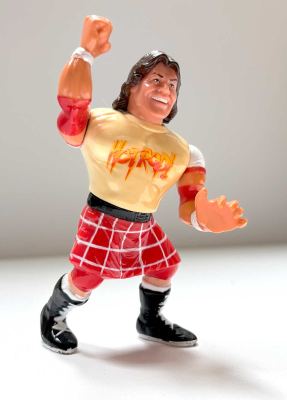
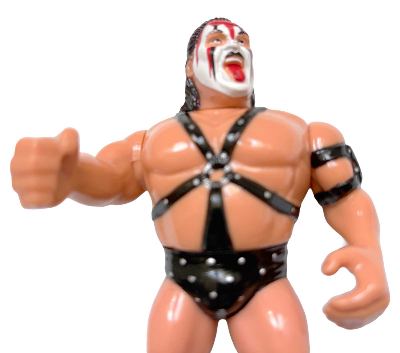
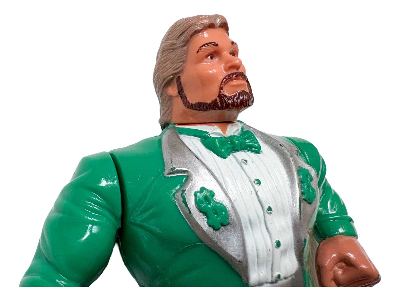
When LJN went under, the biggest roster in wrestling went to Hasbro. What came out was the opposite of LJN's eight-inch rubber giants: small, chunky, cartoonish figures, each built to do one move.
From 1984 the World Wrestling Federation belonged, in toy form, to LJN: eight-inch wrestlers in solid rubber that survived anything a child could do to them. When LJN went out of business at the end of the decade, the licence was free, and Hasbro took it.
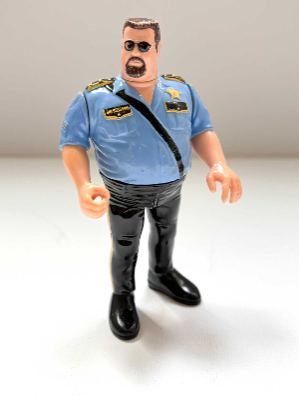
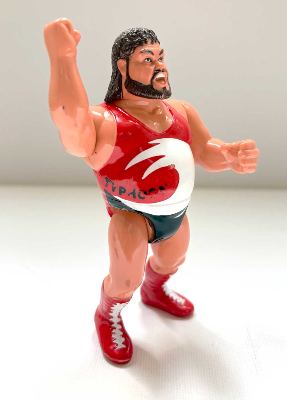
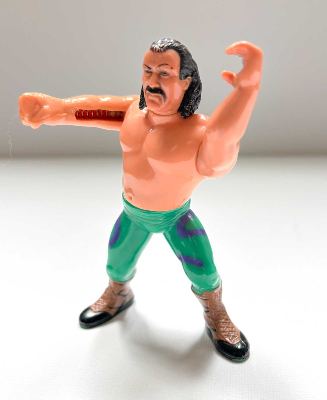
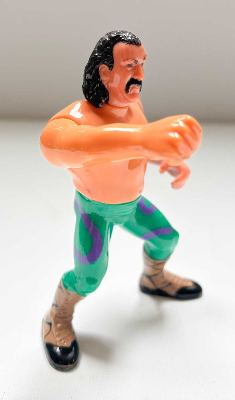
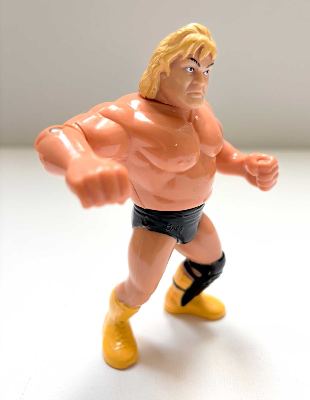
Hasbro did not try to make better rubber men. It made a different toy. The figures stood about four inches tall, were moulded in hard plastic, had four points of articulation and looked more like cartoons than athletes. What they could do instead was wrestle: every figure had its own move, triggered with one simple action, a spring-loaded arm for a punch or a waist that twisted back for a spin.
The first series in 1990 brought Hulk Hogan, Macho Man Randy Savage, Andre the Giant, Jake Roberts and the Ultimate Warrior. Over five years the line grew to eleven regular series, a run of tag team two-packs, rings and playsets, and three figures you could only get by post.
From the first blue cards to the last green ones.
On a carded figure the backing card does the dating for you. Six series on one colour, then a new colour for every series after.
| Series | Card colour | Note |
|---|---|---|
| 1 to 6 | Powder blue | The first six waves, from 1990 |
| 7 | Yellow | The first change of colour |
| 8 | Red | The 1994 Undertaker came on a red card |
| 9 | Purple | |
| 10 | Blue | A darker blue than the first six |
| 11 | Green | The last series, late 1994, made in smaller numbers |
A wrestler needs somewhere to wrestle. Hasbro sold the ring from the start.
The Official Wrestling Ring, item 7030, appeared in Hasbro's 1990 Toy Fair catalogue with ropes, turnbuckles, corner posts, an American flag and a championship belt, built to take the body slams. It was moulded in hard blue plastic.
Variations followed: a JCPenney exclusive packed with Hogan and Macho Man, a version with a sound module, and in 1993 the King of the Ring playset, a yellow ring with spring-action ropes.
Original or reissue? In 2016 Mattel released a retro ring modelled on the Hasbro design. It is easy to tell apart once you know where to look: the reissue has three steps and two small televisions, the original two steps and one television.
The prices below are a snapshot of eBay sales in the spring of 2019, given to show what is scarce, not what anything is worth today.
The mail-aways. In 1993 WWF Magazine offered three figures by post only: the Undertaker, Hulk Hogan and Bret Hart. They came bagged, not carded, and they are among the scarcest wrestling figures ever made. A sealed Undertaker sold for $2,850. The Bret Hart is almost identical to his ordinary series 4 figure, which is why some collectors care less about it despite how few exist.
Common loose, rare carded. Andre the Giant from the first series is easy to find loose for a few tens of euros and very hard to find still on its card, where it sold for $300 to $500. Dusty Rhodes from series 2 is the same story: a carded one went for $700.
Most of these come without a card. This is what we look at.
Our own reading of the toys, checked against the public record. Follow these if you want to go further than we did.
A private collection that grew into something bigger. This is where it comes from, and what we hunt for.
What began as a handful of childhood pieces turned into a hunt: for the odd, the overlooked and the wonderfully strange. The finding, the careful cleaning, the search for a missing weapon or a lost accessory, the stories behind each toy. Somewhere along the way the collecting became a way of living.
We are drawn to the weird ones. Toys that were played with, loved and actually handled, over the pristine pieces sealed and graded never to be opened again. A toy locked in plastic, never to be read or felt, becomes a frozen artifact. We would rather keep them alive.
Have a collection of your own? We buy and take on whole collections and single pieces. Tell us what you have, send a few photos, and we will look after it.
Upload a few clear photos. Our AI identifies the toy, dates it, checks the condition and builds the listing for you. It also reviews recent sales to suggest a fair starting price.
Identification is free. You only use a listing when you decide to sell.
Add clear photos of the front, back, accessories and any visible flaws. Include a close-up of the maker's stamp where possible.
You can also add your own source or a note of direction, either to point us at something you already trust or to have the identification double-checked against it.
A worn or partly legible stamp is fine.
Our AI reads the toy the way Hammer & Mold does, dating it from the moulded stamp rather than the box, then identifies the year, line and variant, grades the condition and reviews recent sales to suggest a price.
You see the identification, the sources, the condition, the pricing and the listing details before anything goes live. Change what you like, set your Reserve or Buy Now price, then approve the listing.
Toy identification is free and unlimited. Photograph anything and we will identify it, date it, show what originally came with it and grade its condition. You only pay when you list. Choose a package based on how much you sell, or let us work out which one costs you least.
You do not have to run an auction to get rid of a box of toys. Send us photographs, we tell you what it is worth, and we make you an offer for the lot. You post one parcel and we pay. No listing, no waiting, no wondering whether it sells.
We would rather you picked the right one than the one that suits us, so here is the arithmetic on a toy we think will fetch €30.
| On a toy worth about €30 | Sell it to us | Sell it through us |
|---|---|---|
| You receive | € 15,00 | € 25,50 |
| When | Within a week | After it sells |
| If it does not sell | Our problem | You still have it |
| Photographs, listing, packing | We do it | You do it |
| If it turns out to be rare | We keep the upside | You keep it |
The honest reason: assessing one toy and assessing forty costs us nearly the same in setup, so a whole collection is worth far more of our attention than a single common figure.
1. You send photographs. A few clear shots of what you have, laid out. For anything you think is worth something, add a close-up of the moulded stamp on the feet or the lower back: that text is what lets us date it and find what it really sells for.
2. We tell you what it is, before we make an offer. You get the identification either way, and you keep it whether you sell to us or not. If we think a piece is worth more than we would pay for it, we will say so and tell you to list it yourself.
3. We make one offer for the lot. Within two working days, with the reasoning attached: what we think each piece fetches and what we are paying for it. No haggling and no fishing.
4. You post it, we pay. We send you a prepaid label. Payment goes out the day the parcel arrives and matches the photographs. If something is not as described you get the parcel back at our cost, not a lower offer.
Photographs and a way to reach you. Nothing else needed, and nothing is committed by sending it.
Toy identification is always free and unlimited. Photograph anything and we will tell you what it is, who made it, when it was made and what condition it is in. You only pay when you sell. Choose a package based on how much you sell each month. Every package includes price research, buyer protection and live postage rates.
Tell us roughly how much you sell. We will compare the monthly fee and selling fee together and recommend the cheapest package.
Compare what buyer and seller pay together. On a €100 hammer price, Catawiki charges the seller 12.5% and adds another 9% buyer fee. The buyer pays €109 while the seller receives €87,50. Hammer & Mold adds no buyer fee. A €100 hammer price means the buyer pays €100.
| On a €100 hammer price | Buyer pays | Seller receives | Total platform fees |
|---|---|---|---|
| Catawiki | € 109,00 | € 87,50 | 21,5% |
| Hammer & Mold, Starter | € 100,00 | € 85,00 | 15,0% |
| Hammer & Mold, Trader | € 100,00 | € 88,00 | 12,0% |
| Hammer & Mold, Dealer | € 100,00 | € 92,00 | 8,0% |
A monthly package fee buys you a lower selling fee. Sell enough in a month and the saving becomes greater than the subscription. Sell less, and Starter is cheaper. The table shows the total cost of each package at different monthly sales volumes.
Live lots from this seller.
Identifying a toy is free and unlimited on every package. A listing is what costs a token. Every package includes the price research, buyer protection on every lot, and postage quoted live from the carrier.