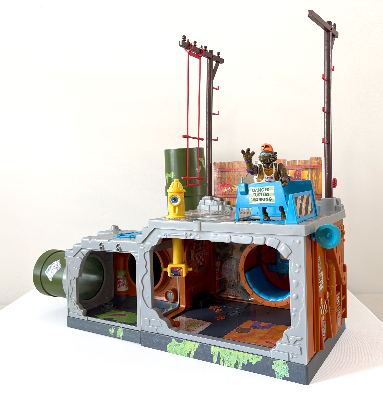
Playmates
Turtle Blimp
1988
The very first vehicle. A soft vinyl blimp the Turtles flew over the city, and one of the pieces in the debut assortment.
Hammer & Mold brings together original vintage toys, the companies that made them and the stories that made them famous. Explore the history. Watch the commercials. Buy the originals.
Live auctions on original vintage toys. Place a bid, or take it straight away with Buy now.
We organize the collection the way it was built: maker first. The maker is the molder; its toy lines live beneath it. Filter the lines by their maker, or sort them across the years.
The line that invented the modern 3¾-inch action figure, and sold an empty box one Christmas to do it.
Meet the Molder →Proton packs, ecto-plasma and gross-out mutations. The strangest, most inventive toys on the shelf.
Meet the Molder →Soft-vinyl monsters from Tokyo's tokusatsu boom. Godzilla, Ultraman and the beasts of late-night television, hand-poured and hand-painted.
Meet the Molder →The material itself. Hollow Japanese soft vinyl, slush-cast in heated metal moulds, pulled out by hand and sprayed by hand. And Hiroshi Goto, who has been painting it for seventy years.
Meet the Molder →Mutant reptiles, pizza and ooze. The line that turned a black-and-white comic into a worldwide phenomenon.
Meet the Molder →The gentle alien of 1982. Poseable figures, glowing fingers and the most famous bicycle in cinema.
Meet the Molder →Mr. T, machine guns and a black van. No plan survived contact, but the toys did.
Meet the Molder →Four inches of hard plastic, one move each, and a ring to throw them in.
Meet the Molder →The monsters you could actually own. Cheap vinyl on a hook by the till, from the company a Holocaust survivor built out of a ten-cent bouncing ball.
Meet the Molder →Britain's Star Wars line, from the company that also made Action Man. Its Death Star is printed card because plastic cost too much, which is exactly why it is now the one collectors chase.
Meet the Molder →The toys about toys. Pull-string Woody and Buzz, straight from Pixar's first feature.
Meet the Molder →Anyone can sell an old toy. We want to tell you what you're actually looking at.
Year, maker, series, scale, accessories and condition. The details collectors actually want to know.
Who made it, when it appeared and what made it special. The story behind the plastic.
The original TV commercials that introduced these toys to the world, right where they belong.
Two cartoonists, a kitchen-table joke and an idea that got wildly out of hand. In four years the Turtles went from a 3,000-copy black-and-white parody to the action figures on every shelf in the Western world.
One night in November 1983, Kevin Eastman and Peter Laird were trading silly drawings in their apartment in Dover, New Hampshire. Eastman sketched a masked turtle standing upright with a pair of nunchucks, and scrawled three words above it as a gag: Teenage Mutant Ninja Turtles. It was a parody, poking fun at the biggest comics of the day, Frank Miller's ninjas, the New Mutants, Dave Sim's Cerebus. It was never meant to leave the room.
But they couldn't let it go. With a tax refund and a loan from Eastman's uncle, around $1,200 between them, the pair self-published a single oversized black-and-white issue in May 1984, under an imprint they invented on the spot: Mirage Studios, so named because the studio didn't really exist. They printed 3,000 copies, priced at $1.50, and mailed out a press release that made the tiny print run sound like an event. It sold out. The gritty little comic became the most talked-about book in the independent scene, and first-printing copies now change hands for the price of a car.
A licensing agent named Mark Freedman saw what the comic could become, and brought it to Playmates Toys, a modest California firm with no action-figure line of its own. Playmates was interested but cautious: they wanted the Turtles on television first, to prove the audience was really there. A five-part animated miniseries aired in December 1987, and it changed everything about them.
Television softened the Turtles into the version the world remembers. In the comic all four wore red masks; on screen each got his own color so children could tell them apart. Michelangelo got the nunchucks and the one-liners, pizza became an obsession, and a whole cast, Krang, Bebop and Rocksteady, the Technodrome, was invented for the show and the toys. When Playmates shipped the first figures in 1988 the line didn't just sell. Within two years the Turtles stood shoulder to shoulder with Star Wars and G.I. Joe as the best-selling toys on Earth.
The short version of a long story: how a parody comic became one of the biggest toy empires of its decade.
Playmates didn't just make figures. It built a whole world in plastic, and these are the pieces collectors still chase.
If the figures were the army, the Technodrome was the empire's fortress. Released in 1990, it was Krang's rolling war-machine rendered in plastic: a giant motorized eyeball that rose from the top, prison cells, a working lift, escape hatches and a firing cannon.
It is the piece almost every collector remembers begging for, and the one that still anchors a serious Turtles collection today. Complete, boxed and unbroken, it is the blue-chip of the range.
We do not have one. The Technodrome is here because the story of this line cannot be told without it, not because it is stock. Nothing in this section is for sale. What we have handled is further down, photographed on our own bench, and the shop is the only place anything is actually offered.
The very first vehicle. A soft vinyl blimp the Turtles flew over the city, and one of the pieces in the debut assortment.
Michelangelo's skateboard, molded to clip a figure on for the ride. One of the earliest accessories and a fixture of the early line.
The armoured van from the cartoon, complete with periscope and spring-loaded cannons. The line's signature vehicle.
A catapult on wheels that flung little plastic pizzas. Half vehicle, half weapon, entirely absurd.
The Foot Clan's answer to the Party Wagon, and the siege engines that filled out the villains' side of the shelf.
Every photograph below is of one European example that came through Haarlem, including the stamp under its base. The plastic and the carton disagree about the year, and both of them are right.
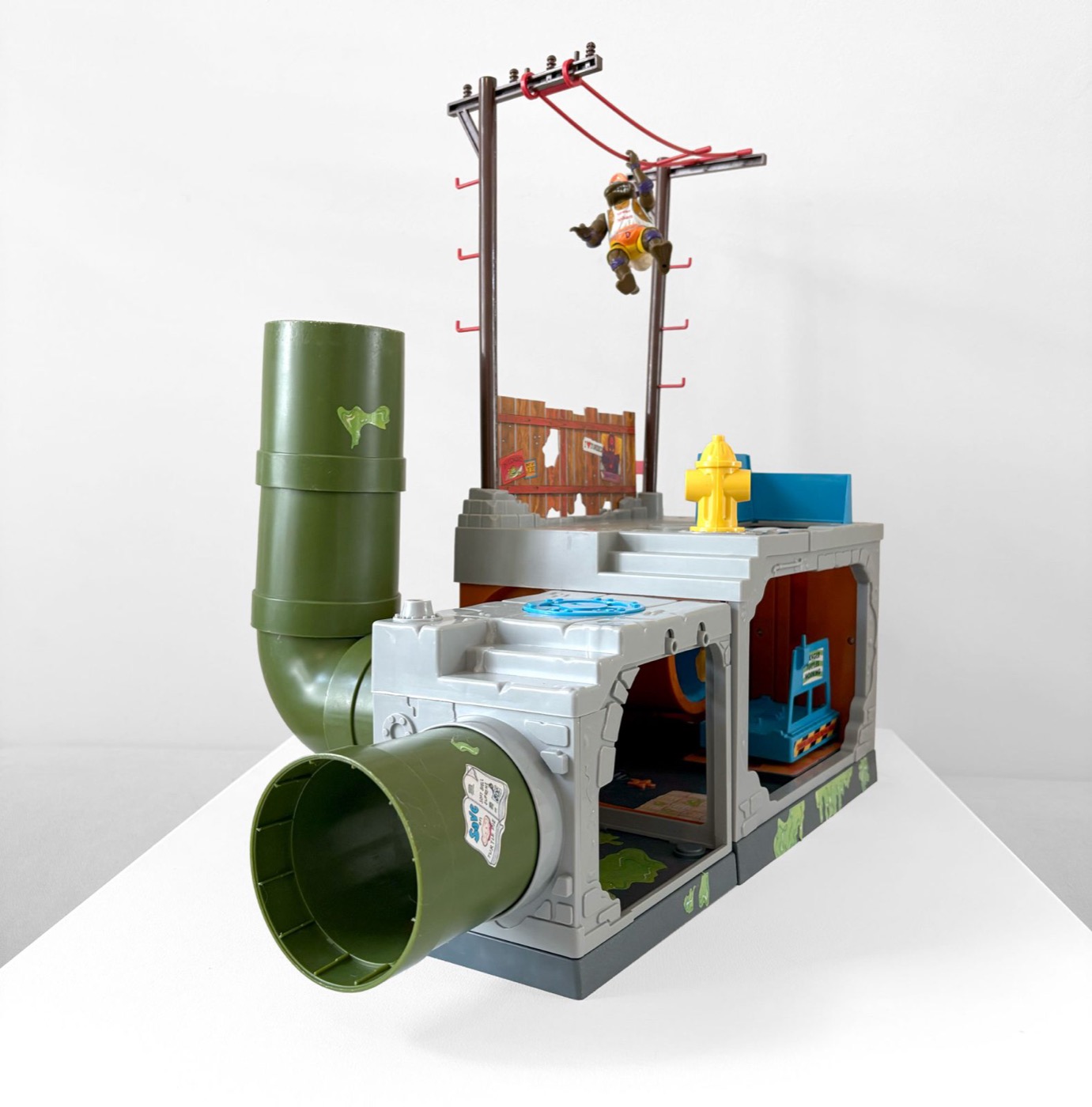
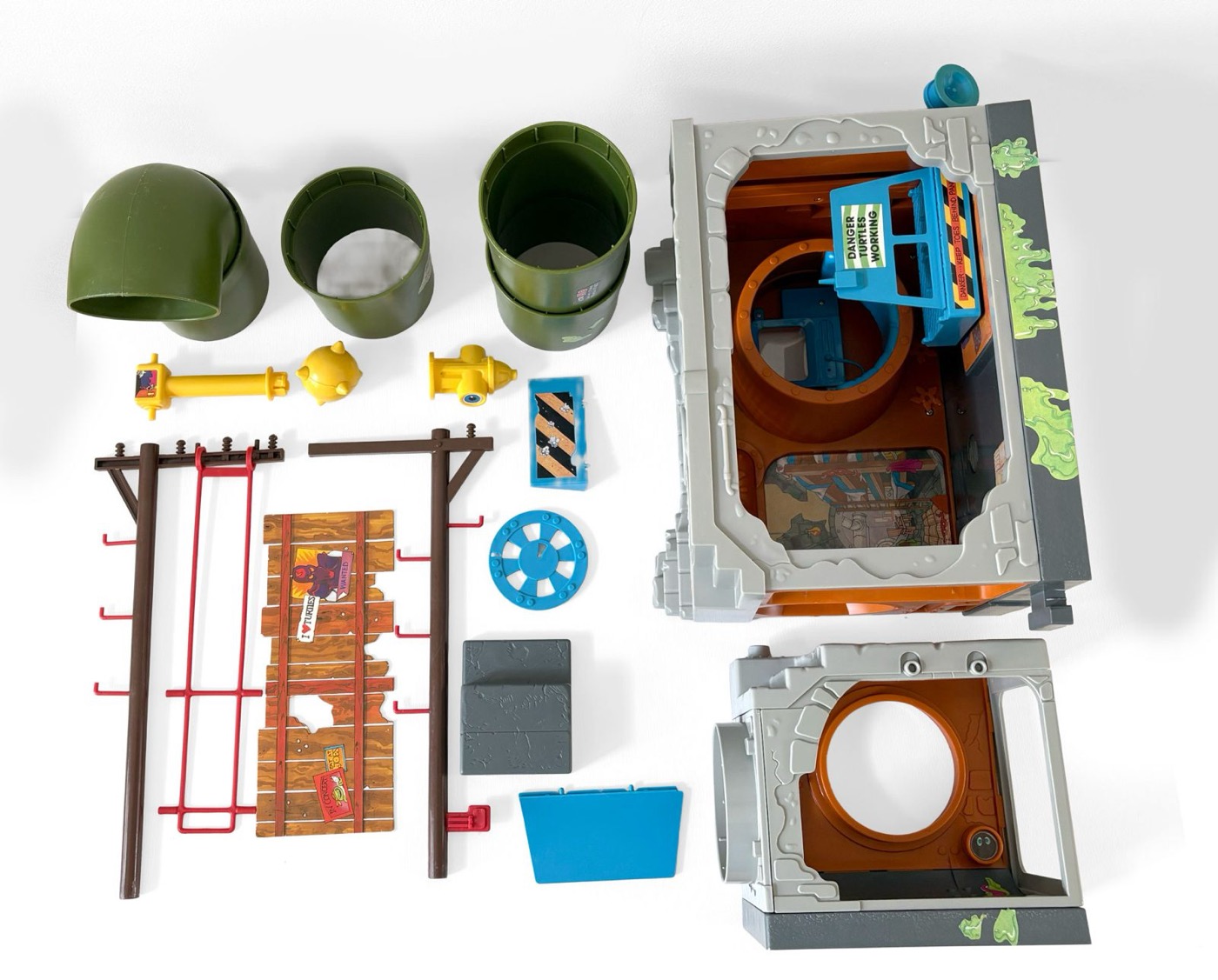
Two chambers, grey brick outside and that particular brownish orange inside, joined at the base and opened at the front so a child can reach in. Green pipes push on and pull off. A yellow post runs an elevator between the floors, and a red cable strung between two telephone poles gives you the battle swing, which is the piece every photograph of this set ends up showing.
The back of the carton labels the rooms like an estate agent: a Sewer Control Center, a turtle computer with a see-through screen, a fire hydrant that doubles as a periscope, and a turtle wreck-reation room, which is the sort of pun somebody was paid for in 1989 and which the German edition sensibly does not attempt.
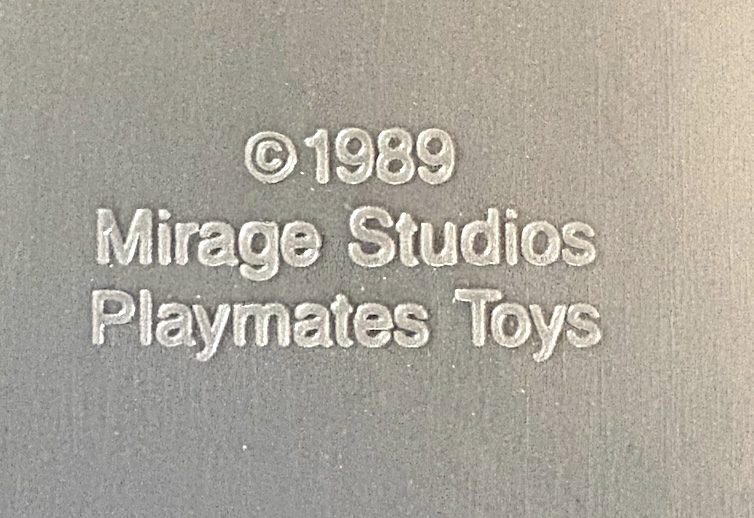
Pressed into the underside, where nobody could get at it afterwards, the tool left its mark: © 1989 Mirage Studios, Playmates Toys. That is the date worth having, and it is the one a photograph of the plastic can settle on its own. It dates the tooling.
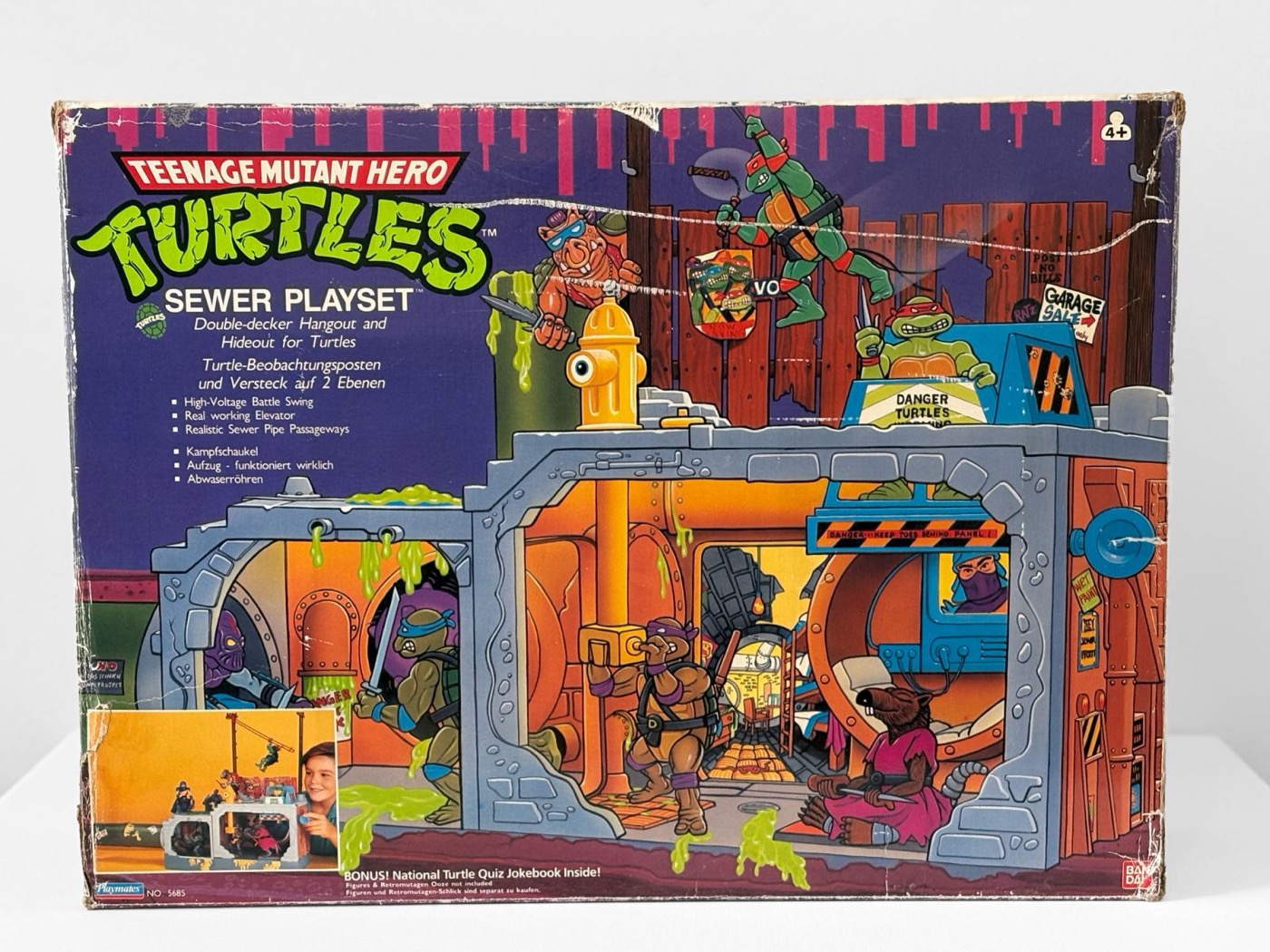
The carton is a different object. In January 1990 the cartoon reached British television with the word ninja taken out of it: out of the title, out of the theme tune, and out of Michelangelo's hands, where the nunchucks became a grappling hook. Britain got Teenage Mutant Hero Turtles, the name carried across the European packaging, and that is why this box, printed in English and German with the Bandai mark beside the Playmates one, says Hero.
So both dates are true and they belong to different things. The stamp says the tool was cut in 1989. The title says this carton was printed in 1990 or later, because the word on it did not exist before then. Listings collapse the two into a single year, and the year they pick is almost always the mould's, which is why a boxed set and a loose one can carry the same date and not be the same age at all.
Laid out flat it is a short list: three green pipe sections, both telephone poles and the red swing between them, the printed fence backdrop with its hole and its posters, the barricade, the manhole cover, the hydrant and its periscope, the lift post, a paving slab, and the two building halves. The Young V&A has one in its permanent collection, accessioned as B.156:1 to 13-2004 and made in Hong Kong, and records it in sixteen parts.
No figures and no Retromutagen Ooze were ever inside. The carton says so in both languages, twice, and a seller apologising for their absence is apologising for the factory. What does go missing is the cardboard: the fence backdrop and the printed panels are the first things a loose set loses, and a complete-but-loose example with its card intact is worth more than the word loose suggests.
The television spots that sold the toys the first time around, straight from the Playmates vault. They play inline here; the title opens the clip on YouTube.
Our own reading of the toys, checked against the public record. Follow these if you want to go further than we did.
A private collection that grew into something bigger. This is where it comes from, and what we hunt for.
What began as a handful of childhood pieces turned into a hunt: for the odd, the overlooked and the wonderfully strange. The finding, the careful cleaning, the search for a missing weapon or a lost accessory, the stories behind each toy. Somewhere along the way the collecting became a way of living.
We are drawn to the weird ones. Toys that were played with, loved and actually handled, over the pristine pieces sealed and graded never to be opened again. A toy locked in plastic, never to be read or felt, becomes a frozen artifact. We would rather keep them alive.
Have a collection of your own? We buy and take on whole collections and single pieces. Tell us what you have, send a few photos, and we will look after it.
Upload a few clear photos. Our AI identifies the toy, dates it, checks the condition and builds the listing for you. It also reviews recent sales to suggest a fair starting price.
Identification is free. You only use a listing when you decide to sell.
Add clear photos of the front, back, accessories and any visible flaws. Include a close-up of the maker's stamp where possible.
You can also add your own source or a note of direction, either to point us at something you already trust or to have the identification double-checked against it.
A worn or partly legible stamp is fine.
Our AI reads the toy the way Hammer & Mold does, dating it from the moulded stamp rather than the box, then identifies the year, line and variant, grades the condition and reviews recent sales to suggest a price.
You see the identification, the sources, the condition, the pricing and the listing details before anything goes live. Change what you like, set your Reserve or Buy Now price, then approve the listing.
Toy identification is free and unlimited. Photograph anything and we will identify it, date it, show what originally came with it and grade its condition. You only pay when you list. Choose a package based on how much you sell, or let us work out which one costs you least.
You do not have to run an auction to get rid of a box of toys. Send us photographs, we tell you what it is worth, and we make you an offer for the lot. You post one parcel and we pay. No listing, no waiting, no wondering whether it sells.
We would rather you picked the right one than the one that suits us, so here is the arithmetic on a toy we think will fetch €30.
| On a toy worth about €30 | Sell it to us | Sell it through us |
|---|---|---|
| You receive | € 15,00 | € 25,50 |
| When | Within a week | After it sells |
| If it does not sell | Our problem | You still have it |
| Photographs, listing, packing | We do it | You do it |
| If it turns out to be rare | We keep the upside | You keep it |
The honest reason: assessing one toy and assessing forty costs us nearly the same in setup, so a whole collection is worth far more of our attention than a single common figure.
1. You send photographs. A few clear shots of what you have, laid out. For anything you think is worth something, add a close-up of the moulded stamp on the feet or the lower back: that text is what lets us date it and find what it really sells for.
2. We tell you what it is, before we make an offer. You get the identification either way, and you keep it whether you sell to us or not. If we think a piece is worth more than we would pay for it, we will say so and tell you to list it yourself.
3. We make one offer for the lot. Within two working days, with the reasoning attached: what we think each piece fetches and what we are paying for it. No haggling and no fishing.
4. You post it, we pay. We send you a prepaid label. Payment goes out the day the parcel arrives and matches the photographs. If something is not as described you get the parcel back at our cost, not a lower offer.
Photographs and a way to reach you. Nothing else needed, and nothing is committed by sending it.
Toy identification is always free and unlimited. Photograph anything and we will tell you what it is, who made it, when it was made and what condition it is in. You only pay when you sell. Choose a package based on how much you sell each month. Every package includes price research, buyer protection and live postage rates.
Tell us roughly how much you sell. We will compare the monthly fee and selling fee together and recommend the cheapest package.
Compare what buyer and seller pay together. On a €100 hammer price, Catawiki charges the seller 12.5% and adds another 9% buyer fee. The buyer pays €109 while the seller receives €87,50. Hammer & Mold adds no buyer fee. A €100 hammer price means the buyer pays €100.
| On a €100 hammer price | Buyer pays | Seller receives | Total platform fees |
|---|---|---|---|
| Catawiki | € 109,00 | € 87,50 | 21,5% |
| Hammer & Mold, Starter | € 100,00 | € 85,00 | 15,0% |
| Hammer & Mold, Trader | € 100,00 | € 88,00 | 12,0% |
| Hammer & Mold, Dealer | € 100,00 | € 92,00 | 8,0% |
A monthly package fee buys you a lower selling fee. Sell enough in a month and the saving becomes greater than the subscription. Sell less, and Starter is cheaper. The table shows the total cost of each package at different monthly sales volumes.
Live lots from this seller.
Identifying a toy is free and unlimited on every package. A listing is what costs a token. Every package includes the price research, buyer protection on every lot, and postage quoted live from the carrier.