The Toy
Know what you're buying
Year, maker, series, scale, accessories and condition. The details collectors actually want to know.
Hammer & Mold brings together original vintage toys, the companies that made them and the stories that made them famous. Explore the history. Watch the commercials. Buy the originals.
Live auctions on original vintage toys. Place a bid, or take it straight away with Buy now.
We organize the collection the way it was built: maker first. The maker is the molder; its toy lines live beneath it. Filter the lines by their maker, or sort them across the years.
The line that invented the modern 3¾-inch action figure, and sold an empty box one Christmas to do it.
Meet the Molder →Proton packs, ecto-plasma and gross-out mutations. The strangest, most inventive toys on the shelf.
Meet the Molder →Soft-vinyl monsters from Tokyo's tokusatsu boom. Godzilla, Ultraman and the beasts of late-night television, hand-poured and hand-painted.
Meet the Molder →The material itself. Hollow Japanese soft vinyl, slush-cast in heated metal moulds, pulled out by hand and sprayed by hand. And Hiroshi Goto, who has been painting it for seventy years.
Meet the Molder →Mutant reptiles, pizza and ooze. The line that turned a black-and-white comic into a worldwide phenomenon.
Meet the Molder →The gentle alien of 1982. Poseable figures, glowing fingers and the most famous bicycle in cinema.
Meet the Molder →Mr. T, machine guns and a black van. No plan survived contact, but the toys did.
Meet the Molder →The monsters you could actually own. Cheap vinyl on a hook by the till, from the company a Holocaust survivor built out of a ten-cent bouncing ball.
Meet the Molder →Britain's Star Wars line, from the company that also made Action Man. Its Death Star is printed card because plastic cost too much, which is exactly why it is now the one collectors chase.
Meet the Molder →The toys about toys. Pull-string Woody and Buzz, straight from Pixar's first feature.
Meet the Molder →Anyone can sell an old toy. We want to tell you what you're actually looking at.
Year, maker, series, scale, accessories and condition. The details collectors actually want to know.
Who made it, when it appeared and what made it special. The story behind the plastic.
The original TV commercials that introduced these toys to the world, right where they belong.
Almost every object in this shop started as a cavity cut into a block of steel. Four different processes filled those cavities, and each one leaves its own evidence on the finished piece: a seam, a circle, a thickened ridge, a line of raised text on the back of a leg. None of it is damage. It is the manufacturing record, and once you can read it you can tell how a toy was made, often where, and usually when.
A collector learns early to look for a seam down the side of a figure and a ring of faint circles on its back, and a collector who has not been told what those are tends to read them as wear, or as a sign of a cheap copy. They are neither. They are the places where the tool opened and where the part was pushed off it, and they are present on the finest Kenner figure ever made.
What they are worth is information. The process tells you what the thing is: a hollow soft-vinyl monster and a hard styrene action figure are different objects made in different buildings, and they age differently, clean differently and break differently. And the one piece of text that is unique to your particular toy, the moulded stamp, is cut into the tool itself. It is the closest thing a mass-produced object has to a birth certificate.
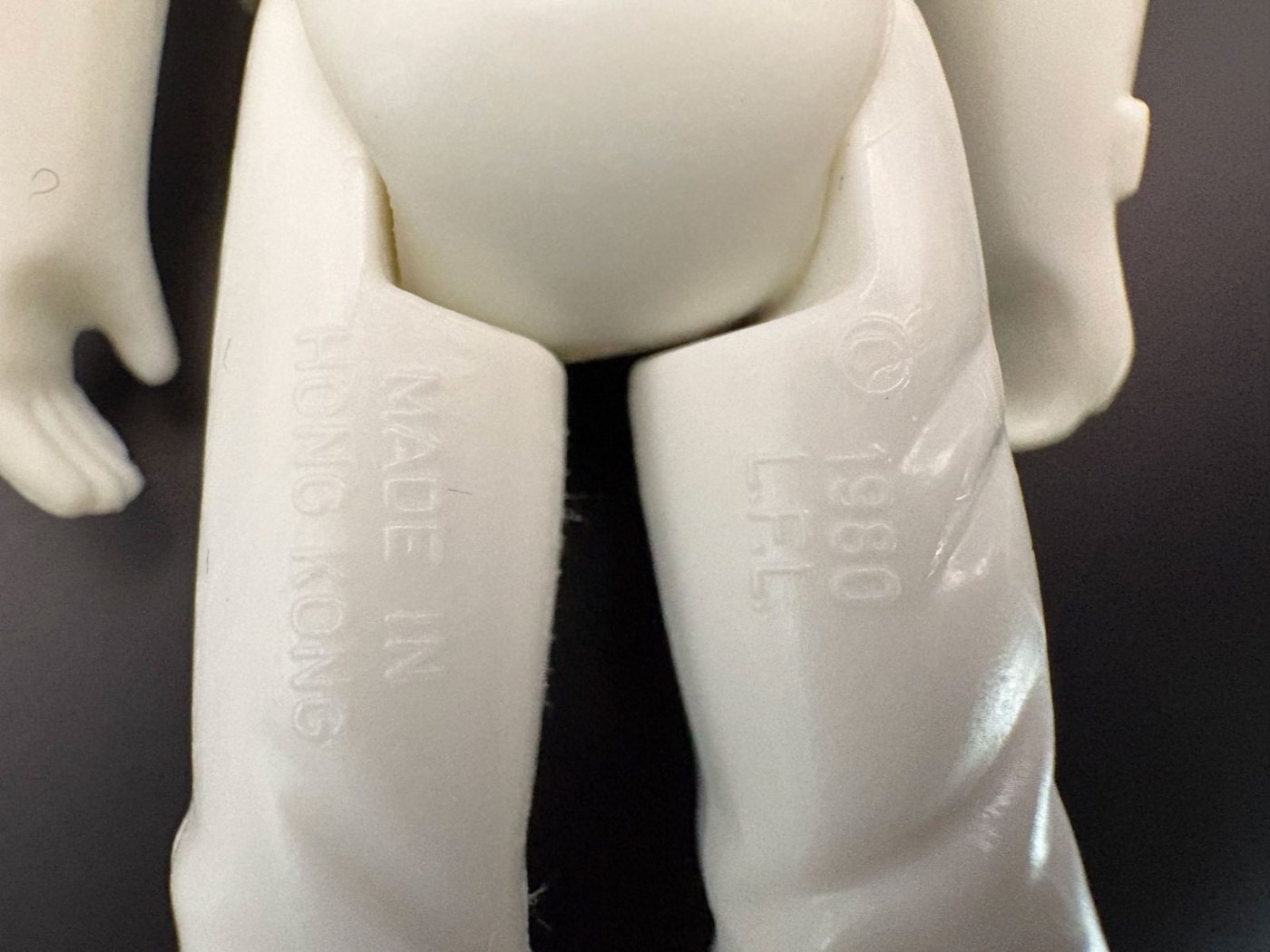
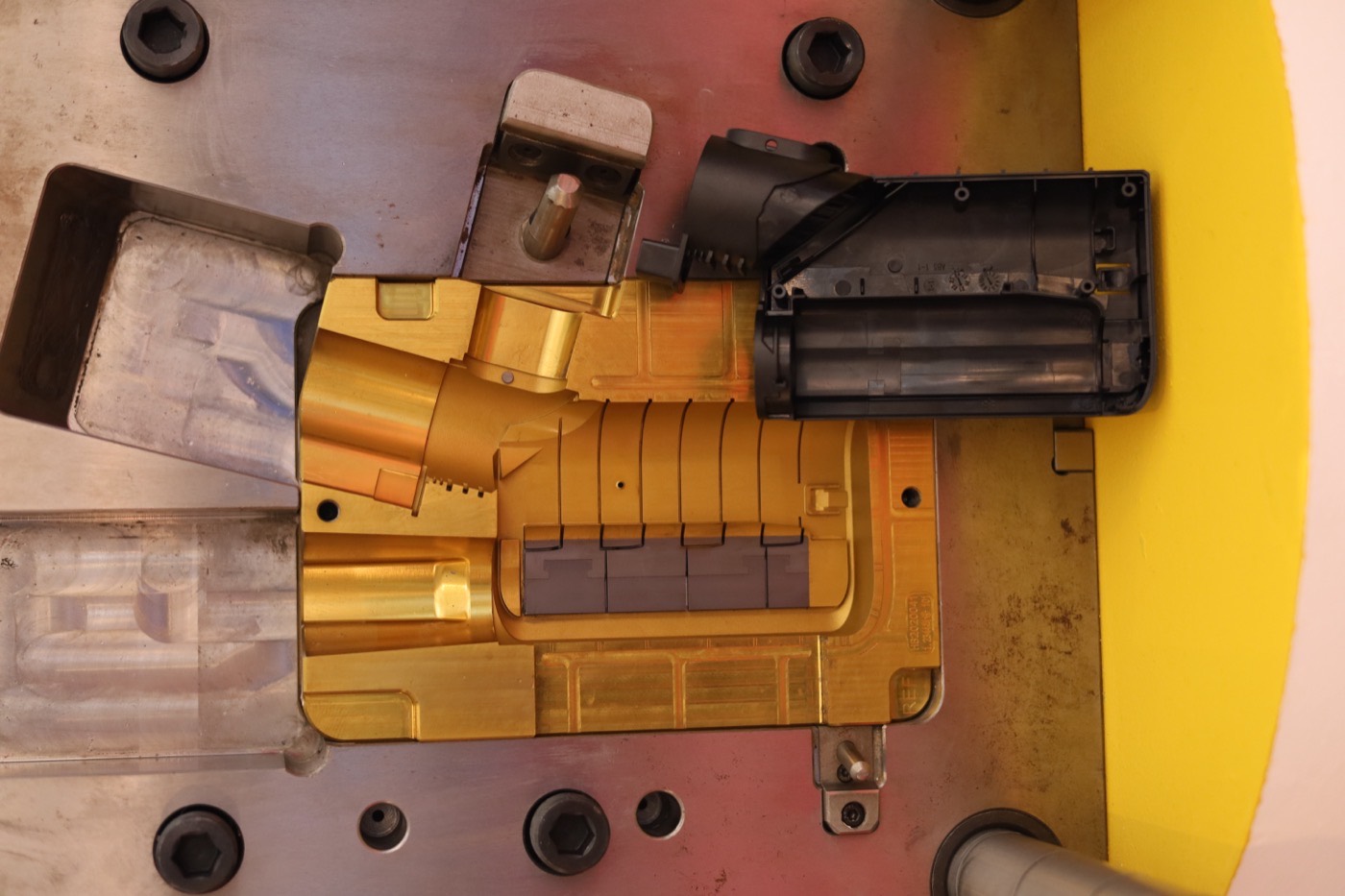
Hard plastic, sharp detail, enormous numbers. Nearly every action figure, vehicle and playset wall in this shop came out of a steel injection tool.
A tool is two halves. The cavity cuts the outside of the part and the core forms the inside, both machined out of tool steel, typically P20, H13, S7 or 420 stainless. Molten plastic is forced in through a tapered sprue, along a runner to each cavity, and through a gate into the part itself. Water runs through drilled channels to cool it. Air escapes through vents ground to less than 0.02 mm, small enough that plastic will not follow it out.
Then the halves separate and ejector pins push the part off the core. A rectangular part needs at least four, one at each corner. A cylindrical one needs three at 120 degrees. A sleeve can do the job instead and leaves nothing behind, which is why some parts have no pin marks at all.
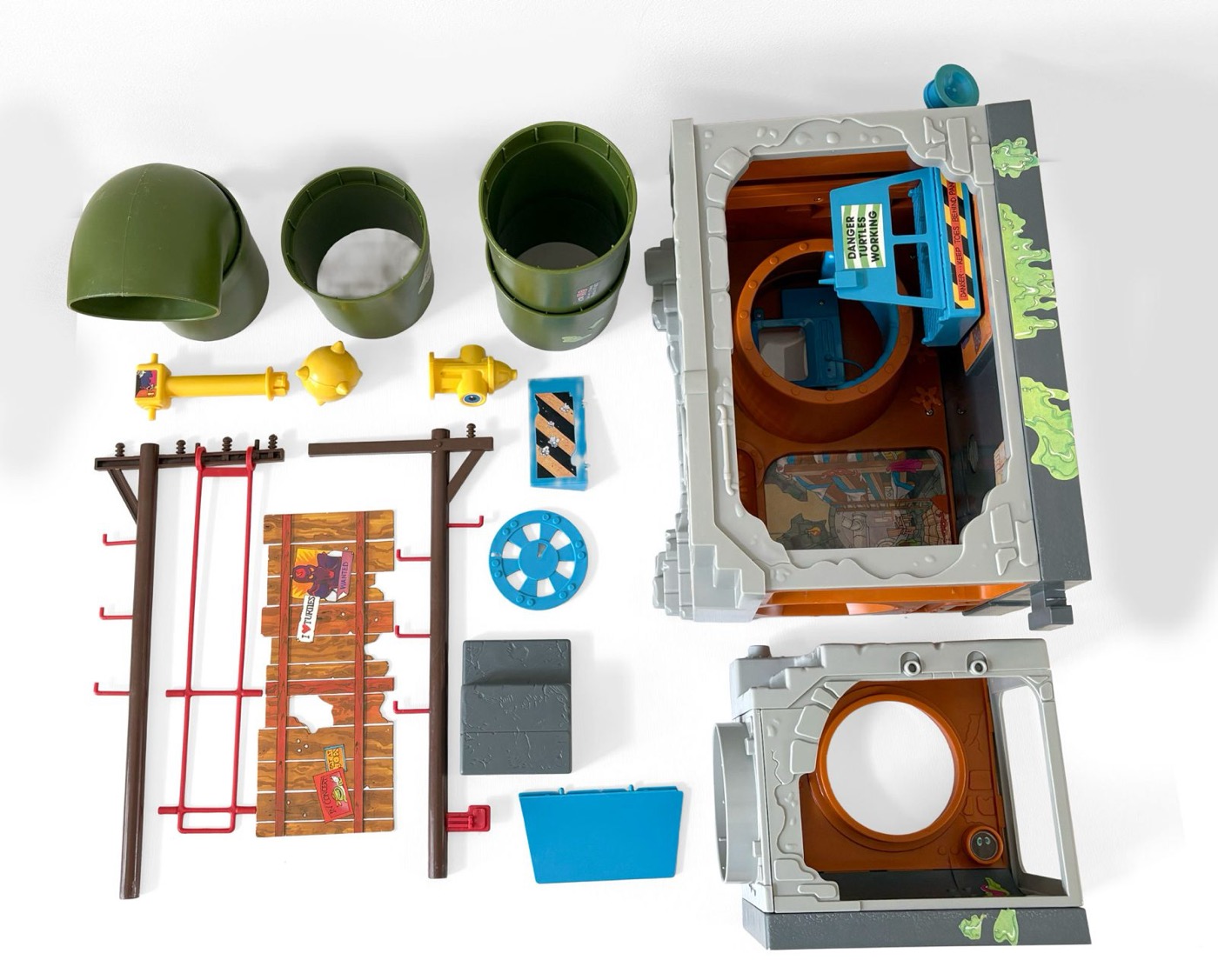
One tool usually holds several cavities, and one shot fills all of them in one colour. That is the whole reason a playset arrives as a bag of brown railings, a bag of red ladders and a bag of grey walls: those are not assortments, they are shots.
Soft, hollow, light, and warm to the touch. Vinyl monsters, squeeze toys, dolls' heads and limbs.
Here the mould is not injected but filled and tipped. Liquid vinyl goes into a heated metal mould, the mould is turned so the liquid coats the inside, and the surplus is poured back out. What sets against the wall is the toy. What drains away is used again, which is exactly why the figure is hollow.
There are no ejector pins because nothing is pushed off a core: the part is pulled out of the mould by hand, often through its own opening, which is why a rotocast figure has a hole somewhere you are not meant to look. There is a seam, but a soft one. And because the final colour is sprayed on afterwards rather than mixed into the shot, two figures from the same mould genuinely do not match.
The Japanese branch of this, and the painter who has been colouring it for seventy years, has its own page.
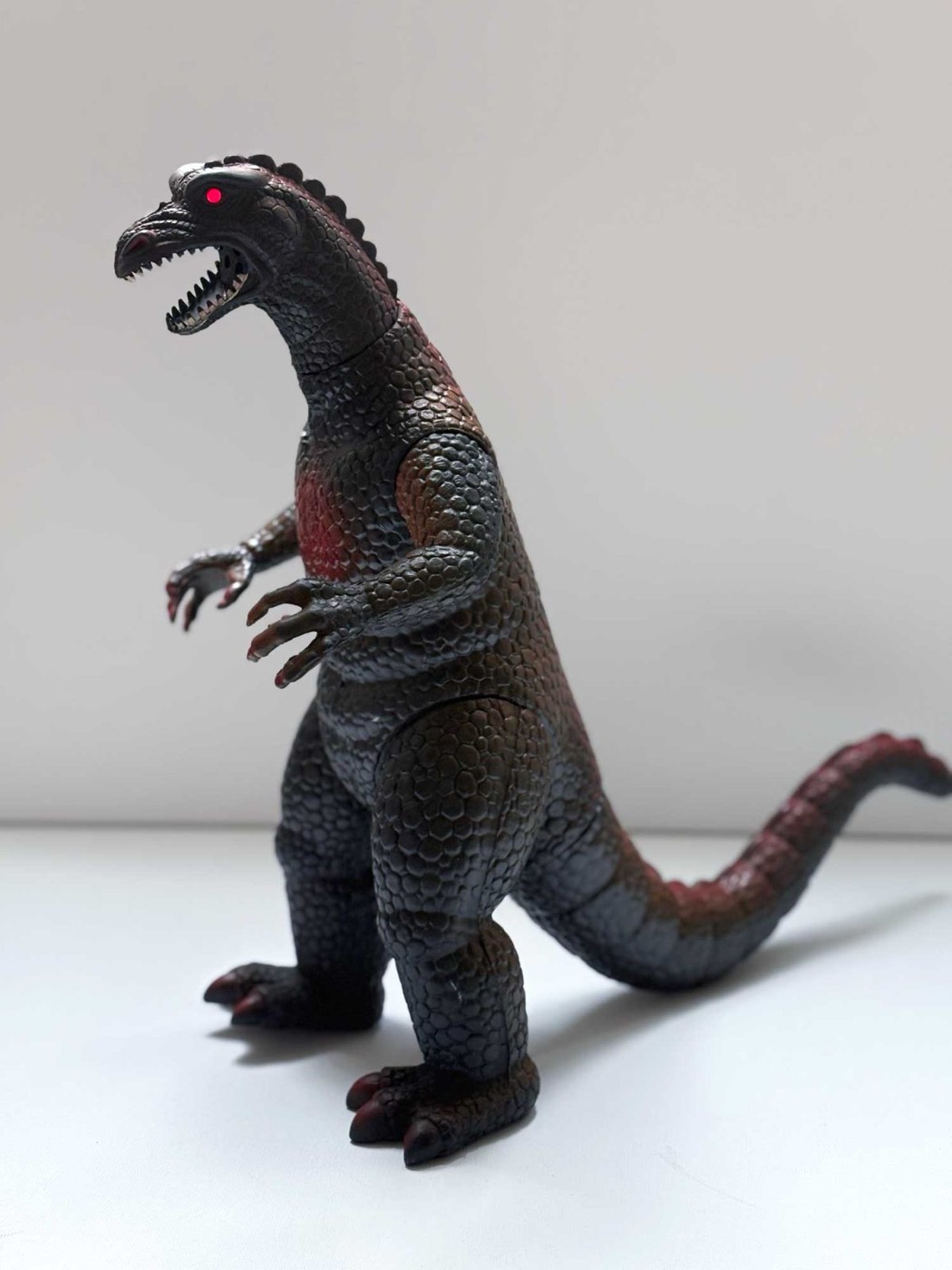
Big hollow things. Ride-on toys, bats, bowling pins, the larger vehicle bodies, anything that had to be light and cheap and enormous.
A soft tube of hot plastic, a parison, is hung between the two halves of a mould. The mould closes on it, pinching it shut at the ends, and air is blown in until the tube balloons against the walls. It is the same thing that makes a milk bottle, scaled up and given a face.
It leaves a tell that nothing else does. Where the mould pinched the tube closed, the material is folded on itself, so the seam is thicker than the wall around it rather than thinner. Usually it runs along the bottom or round the back where it will not be looked at, and on a cheaper piece it was never trimmed off at all.
The cheapest way to get a shape, and the reason so much of a playset is scenery rather than structure.
A flat sheet of plastic is heated until it sags, laid over a tool, and the air underneath is sucked out so the sheet is pulled down onto the shape. No second half, no injection, no pressure to speak of. Minutes of work and a tool that can be made of wood or resin instead of hardened steel.
You can read it instantly once you know: the inside is a perfect negative of the outside, because there is only one surface. It thins at the corners, where the sheet had to stretch furthest, so deep detail goes pale and slightly translucent. And there is no parting line anywhere, because the mould never closed on anything.
Playset terrain, the trays inside a carded blister, and the blister itself are all this process.
The same idea in metal, and the reason a Matchbox car feels like it does.
Molten zinc alloy, usually a zamak, is forced under pressure into a hardened steel die. The sequence is injection moulding exactly, with a melt that happens to be metal: two halves, a gate, ejector pins, a parting line. The difference is in the hand. It is heavy, it holds a crisper edge than any plastic will, and where it has been dropped it dents instead of cracking.
In this trade that means Matchbox and Hot Wheels bodies, and in Japan it means Chogokin, the die-cast super-robots Popy built Bandai's business on.
Squeeze it, tap it, turn it over, find the seam. Four questions and you have the process.
That last one is the one worth the most. A moulded date is cut into the steel, so it dates the tool rather than the production run, and a tool stays in service for years. It is why a figure stamped 1980 can have left the factory in 1983, and why we date from the stamp and say so on every lot. If a stamp is worn to the point of being unreadable, that is itself a fact about the tool: steel wears, and the later the pull, the softer the letters.
What a mark is not is a reason to discount a piece. If a listing of ours calls out a seam, a pin circle or a gate dot, that is a description of how it was made. The things we do grade down are in condition and surface, which is a different page.
One for each process, in the order above, plus the one that is about the tools themselves: where the steel that made the vintage Kenner figures actually went. They play inline here; the title opens the clip on YouTube.
The tooling detail is from engineering references rather than the collecting hobby, because the hobby tends to describe these marks without saying what made them. The photographs are of pieces that have passed through this shop.
A private collection that grew into something bigger. This is where it comes from, and what we hunt for.
What began as a handful of childhood pieces turned into a hunt: for the odd, the overlooked and the wonderfully strange. The finding, the careful cleaning, the search for a missing weapon or a lost accessory, the stories behind each toy. Somewhere along the way the collecting became a way of living.
We are drawn to the weird ones. Toys that were played with, loved and actually handled, over the pristine pieces sealed and graded never to be opened again. A toy locked in plastic, never to be read or felt, becomes a frozen artifact. We would rather keep them alive.
Have a collection of your own? We buy and take on whole collections and single pieces. Tell us what you have, send a few photos, and we will look after it.
Upload a few clear photos. Our AI identifies the toy, dates it, checks the condition and builds the listing for you. It also reviews recent sales to suggest a fair starting price.
Identification is free. You only use a listing when you decide to sell.
Add clear photos of the front, back, accessories and any visible flaws. Include a close-up of the maker's stamp where possible.
You can also add your own source or a note of direction, either to point us at something you already trust or to have the identification double-checked against it.
A worn or partly legible stamp is fine.
Our AI reads the toy the way Hammer & Mold does, dating it from the moulded stamp rather than the box, then identifies the year, line and variant, grades the condition and reviews recent sales to suggest a price.
You see the identification, the sources, the condition, the pricing and the listing details before anything goes live. Change what you like, set your Reserve or Buy Now price, then approve the listing.
Toy identification is free and unlimited. Photograph anything and we will identify it, date it, show what originally came with it and grade its condition. You only pay when you list. Choose a package based on how much you sell, or let us work out which one costs you least.
You do not have to run an auction to get rid of a box of toys. Send us photographs, we tell you what it is worth, and we make you an offer for the lot. You post one parcel and we pay. No listing, no waiting, no wondering whether it sells.
We would rather you picked the right one than the one that suits us, so here is the arithmetic on a toy we think will fetch €30.
| On a toy worth about €30 | Sell it to us | Sell it through us |
|---|---|---|
| You receive | € 15,00 | € 25,50 |
| When | Within a week | After it sells |
| If it does not sell | Our problem | You still have it |
| Photographs, listing, packing | We do it | You do it |
| If it turns out to be rare | We keep the upside | You keep it |
The honest reason: assessing one toy and assessing forty costs us nearly the same in setup, so a whole collection is worth far more of our attention than a single common figure.
1. You send photographs. A few clear shots of what you have, laid out. For anything you think is worth something, add a close-up of the moulded stamp on the feet or the lower back: that text is what lets us date it and find what it really sells for.
2. We tell you what it is, before we make an offer. You get the identification either way, and you keep it whether you sell to us or not. If we think a piece is worth more than we would pay for it, we will say so and tell you to list it yourself.
3. We make one offer for the lot. Within two working days, with the reasoning attached: what we think each piece fetches and what we are paying for it. No haggling and no fishing.
4. You post it, we pay. We send you a prepaid label. Payment goes out the day the parcel arrives and matches the photographs. If something is not as described you get the parcel back at our cost, not a lower offer.
Photographs and a way to reach you. Nothing else needed, and nothing is committed by sending it.
Toy identification is always free and unlimited. Photograph anything and we will tell you what it is, who made it, when it was made and what condition it is in. You only pay when you sell. Choose a package based on how much you sell each month. Every package includes price research, buyer protection and live postage rates.
Tell us roughly how much you sell. We will compare the monthly fee and selling fee together and recommend the cheapest package.
Compare what buyer and seller pay together. On a €100 hammer price, Catawiki charges the seller 12.5% and adds another 9% buyer fee. The buyer pays €109 while the seller receives €87,50. Hammer & Mold adds no buyer fee. A €100 hammer price means the buyer pays €100.
| On a €100 hammer price | Buyer pays | Seller receives | Total platform fees |
|---|---|---|---|
| Catawiki | € 109,00 | € 87,50 | 21,5% |
| Hammer & Mold, Starter | € 100,00 | € 85,00 | 15,0% |
| Hammer & Mold, Trader | € 100,00 | € 88,00 | 12,0% |
| Hammer & Mold, Dealer | € 100,00 | € 92,00 | 8,0% |
A monthly package fee buys you a lower selling fee. Sell enough in a month and the saving becomes greater than the subscription. Sell less, and Starter is cheaper. The table shows the total cost of each package at different monthly sales volumes.
Live lots from this seller.
Identifying a toy is free and unlimited on every package. A listing is what costs a token. Every package includes the price research, buyer protection on every lot, and postage quoted live from the carrier.