The factory
Maruyama Toys
Showa –
Katsushika, Tokyo. Pouring, cooking and pulling by the same method it used when sofubi was first commercialised, in a residential back street.
Hammer & Mold brings together original vintage toys, the companies that made them and the stories that made them famous. Explore the history. Watch the commercials. Buy the originals.
Live auctions on original vintage toys. Place a bid, or take it straight away with Buy now.
We organize the collection the way it was built: maker first. The maker is the molder; its toy lines live beneath it. Filter the lines by their maker, or sort them across the years.
The line that invented the modern 3¾-inch action figure, and sold an empty box one Christmas to do it.
Meet the Molder →Proton packs, ecto-plasma and gross-out mutations. The strangest, most inventive toys on the shelf.
Meet the Molder →Soft-vinyl monsters from Tokyo's tokusatsu boom. Godzilla, Ultraman and the beasts of late-night television, hand-poured and hand-painted.
Meet the Molder →The material itself. Hollow Japanese soft vinyl, slush-cast in heated metal moulds, pulled out by hand and sprayed by hand. And Hiroshi Goto, who has been painting it for seventy years.
Meet the Molder →Mutant reptiles, pizza and ooze. The line that turned a black-and-white comic into a worldwide phenomenon.
Meet the Molder →The gentle alien of 1982. Poseable figures, glowing fingers and the most famous bicycle in cinema.
Meet the Molder →Mr. T, machine guns and a black van. No plan survived contact, but the toys did.
Meet the Molder →Four inches of hard plastic, one move each, and a ring to throw them in.
Meet the Molder →The monsters you could actually own. Cheap vinyl on a hook by the till, from the company a Holocaust survivor built out of a ten-cent bouncing ball.
Meet the Molder →Britain's Star Wars line, from the company that also made Action Man. Its Death Star is printed card because plastic cost too much, which is exactly why it is now the one collectors chase.
Meet the Molder →The toys about toys. Pull-string Woody and Buzz, straight from Pixar's first feature.
Meet the Molder →Anyone can sell an old toy. We want to tell you what you're actually looking at.
Year, maker, series, scale, accessories and condition. The details collectors actually want to know.
Who made it, when it appeared and what made it special. The story behind the plastic.
The original TV commercials that introduced these toys to the world, right where they belong.
Not a company and not a character. Sofubi is a material and a way of working: hollow Japanese toys slush-cast from soft vinyl in heated metal moulds, pulled out of those moulds by hand, and sprayed by hand afterwards. Seventy years on, the method has barely changed, and the last stretch of it is still a person with an airbrush deciding what colour a monster is.
Sofubi is a contraction of sofuto biniiru, soft vinyl, and the reason Japan has a word for it at all is a piece of American safety law. In 1953 the United States banned flammable celluloid in consumer products. Japanese toy companies had built their export business on celluloid, and almost overnight they had to find something else to pour. They found PVC, soft and cheap and bright, and in the same year Masudaya put out what is generally held to be the first Japanese soft-vinyl doll: a baby that drank milk.
The monsters came later. When Ultra Q and Ultraman set off the tokusatsu boom in 1966, Marusan answered with a Godzilla cast in this new material, and the kaiju figure was born. That story has a page of its own. This one is about the stuff itself, and about the hands it passes through on the way to a shelf.

Rotocasting, also called slush casting. It is the same sequence Maruyama Toys was running in Katsushika sixty years ago, in a workshop in a quiet residential street, and it is the reason a sofubi figure is hollow and light and never quite identical to the one beside it.
A blank pull is a single colour. Everything after that is spray, and the masks that shape it.
Detail is laid down through thin copper paint masks, cut to the shape of a stripe or a jaw or an eye and held against the figure while the colour goes on. A simple toy might need one or two. A complicated one can take more than a dozen, each registered against the last, each a separate pass.
Between and around the masks, the work is freehand airbrush. That is the whole explanation for something collectors notice constantly and rarely account for: two figures out of the same mould, same factory, same week, will not match. The vinyl is identical. The hand is not.
Which is also why, in a trade with this many companies in the chain, the name people actually learn is the painter's.
Behind a house in Yotsugi, in Tokyo's Katsushika ward, there is a small weathered building with paint cans along the wall, unpainted figures stacked in boxes, a counter to work at and a chair for whoever has come to collect. The roof leaks. Goto Hiroshi has mentioned fixing it, and then mentioned the rain again, and gone on working. This is the Goto Coloring Workshop. Asked how many soft-vinyl toys he has painted, he says he lost count past a million.
He was born around 1937 and he did not come to this sideways. His father ran a celluloid toy factory and hand-painted the output himself, and Goto grew up in that workshop and learned to mix colour there as a boy. Then the celluloid ban came, the material changed under the whole industry, and the son carried his father's trade across to the thing that replaced it. He has been painting soft vinyl ever since, which by now is more than seventy years.
The collecting trade has it that he started as a teenager at Marusan, the company that cast the first kaiju in vinyl and whose story is on the kaiju page. We have found that in one place and not two, so treat it as the trade's account rather than a fact we can stand behind. What is not in doubt is that he was there at the start and is still at it.
Collectors in America and Europe know him as Master Goto. He does sign: H. GOTO, brushed by hand across the back of a piece. But that is not how the work is usually known. It is known by the colour, and people who have handled enough of it name it before they turn the figure over.

Two things, and only one of them is a technique.
The first is mixing. His gradations are built out of dozens of blended pigments, and people who have handled enough of his work can name it on sight without being told. The trade calls them Goto colors, and the name does more work than the signature does.
The second is the shadows. Once a figure is painted and finished, he sprays the whole of it with a dark paint of his own formulation and immediately wipes it back off. What stays behind sits in the recesses, and the figure gains depth it did not have a moment earlier. The reason nobody else does this is the paint: his lifts off cleanly without taking the colours underneath with it, and it dries fast enough that the whole move happens in seconds. Both halves of that are his own recipe.
He works with the Tokyo shop One Up, in Nakano Broadway and Akihabara, and with sofubi builders including Picopico and Gum Taro. In 2019 Volkswagen Japan built a brand film around him and released two original kaiju he painted, Tanger and Okiterun, a hundred hand-painted of each. In 2020 TV Tokyo turned up in Yotsugi to film him for a programme about the neighbourhood.
There is a version of this page that treats that as sad. It is not quite the right note. The work is not preserved, it is simply still being done: a man in his late eighties, at a counter, under a roof he has repaired, painting monsters that will be shipped to Mexico.
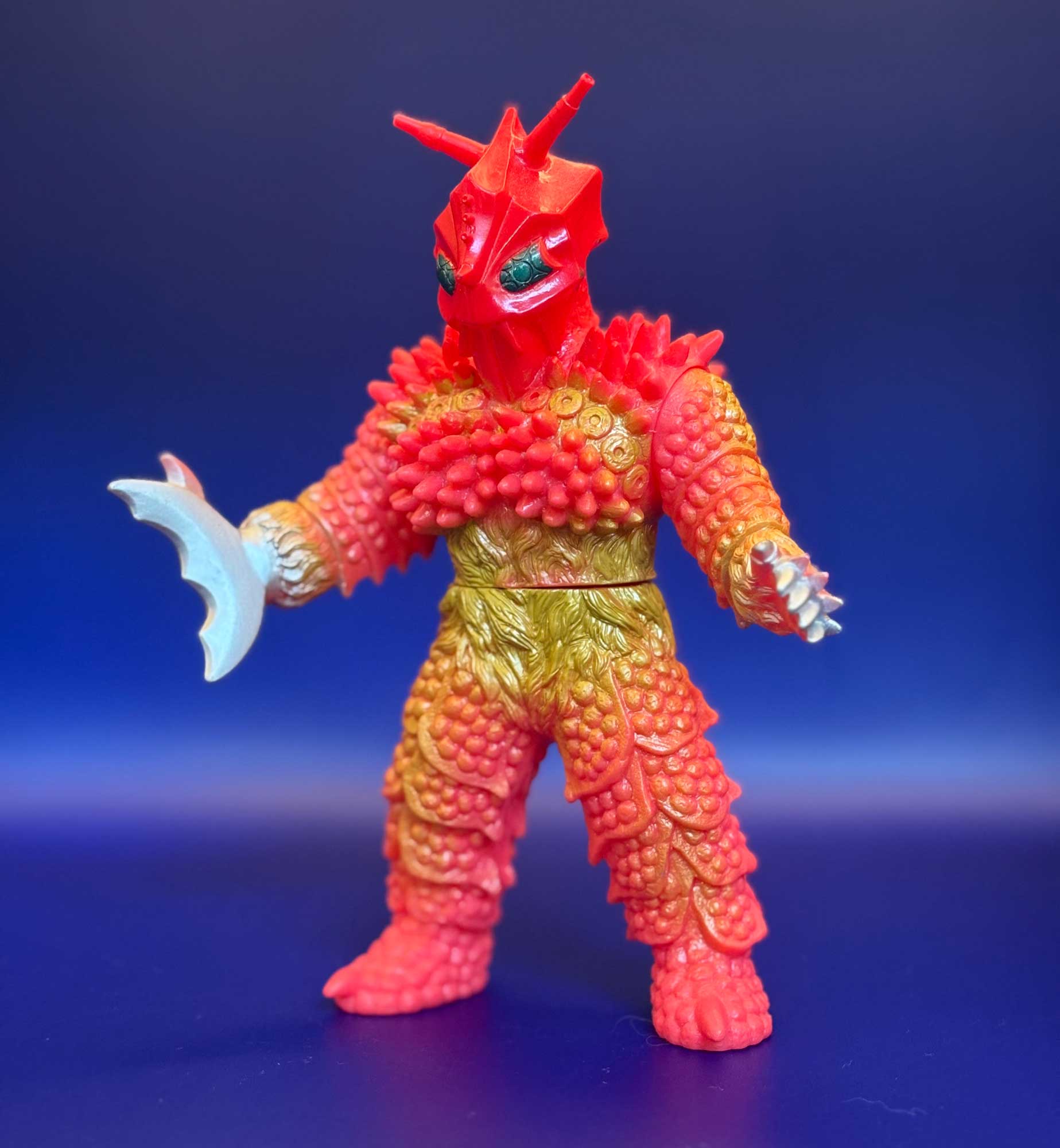
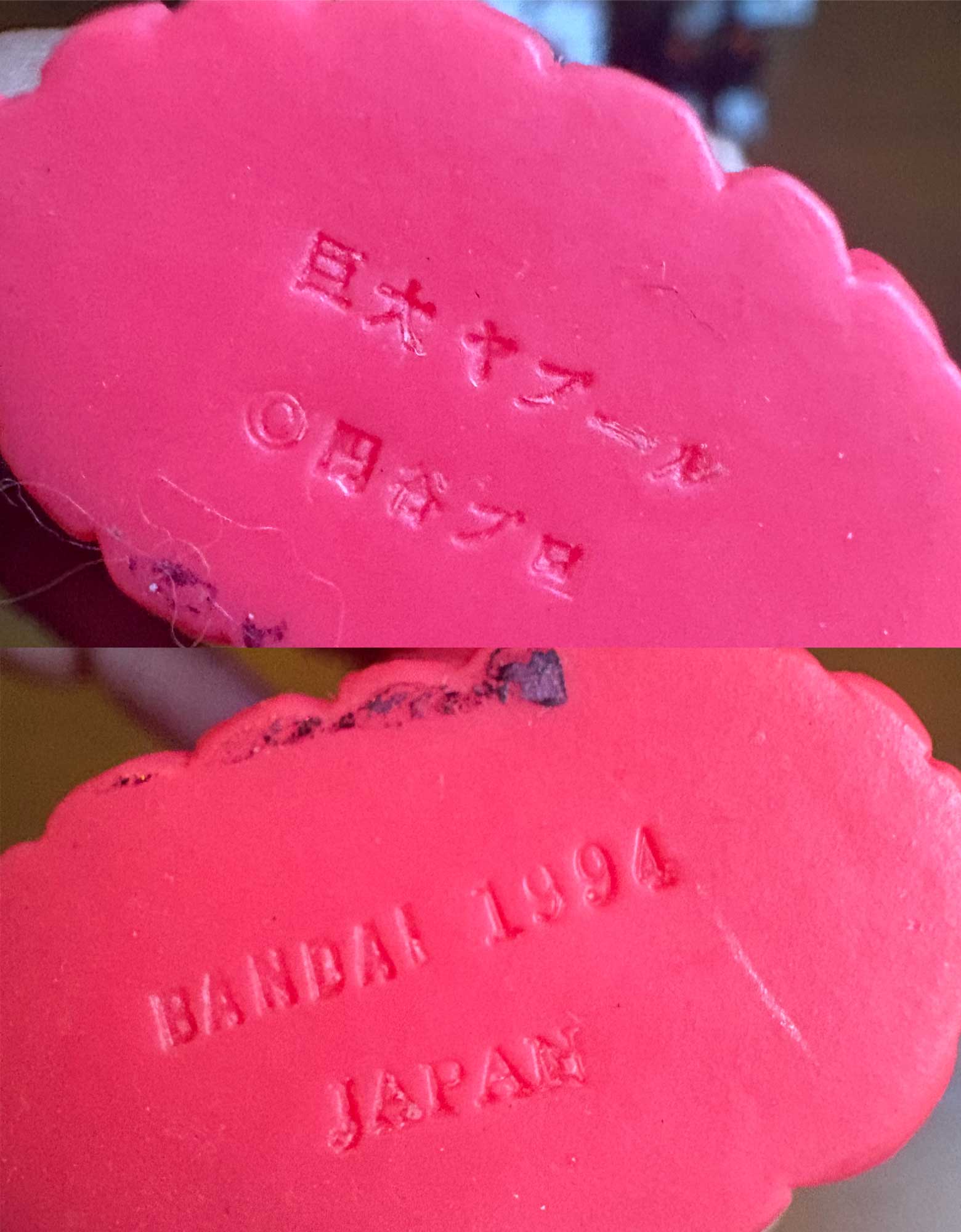
Everything above is how the material behaves. This is one piece of it that came through Haarlem, photographed here rather than taken from a catalogue, with the stamp under the foot that says who made it and when.
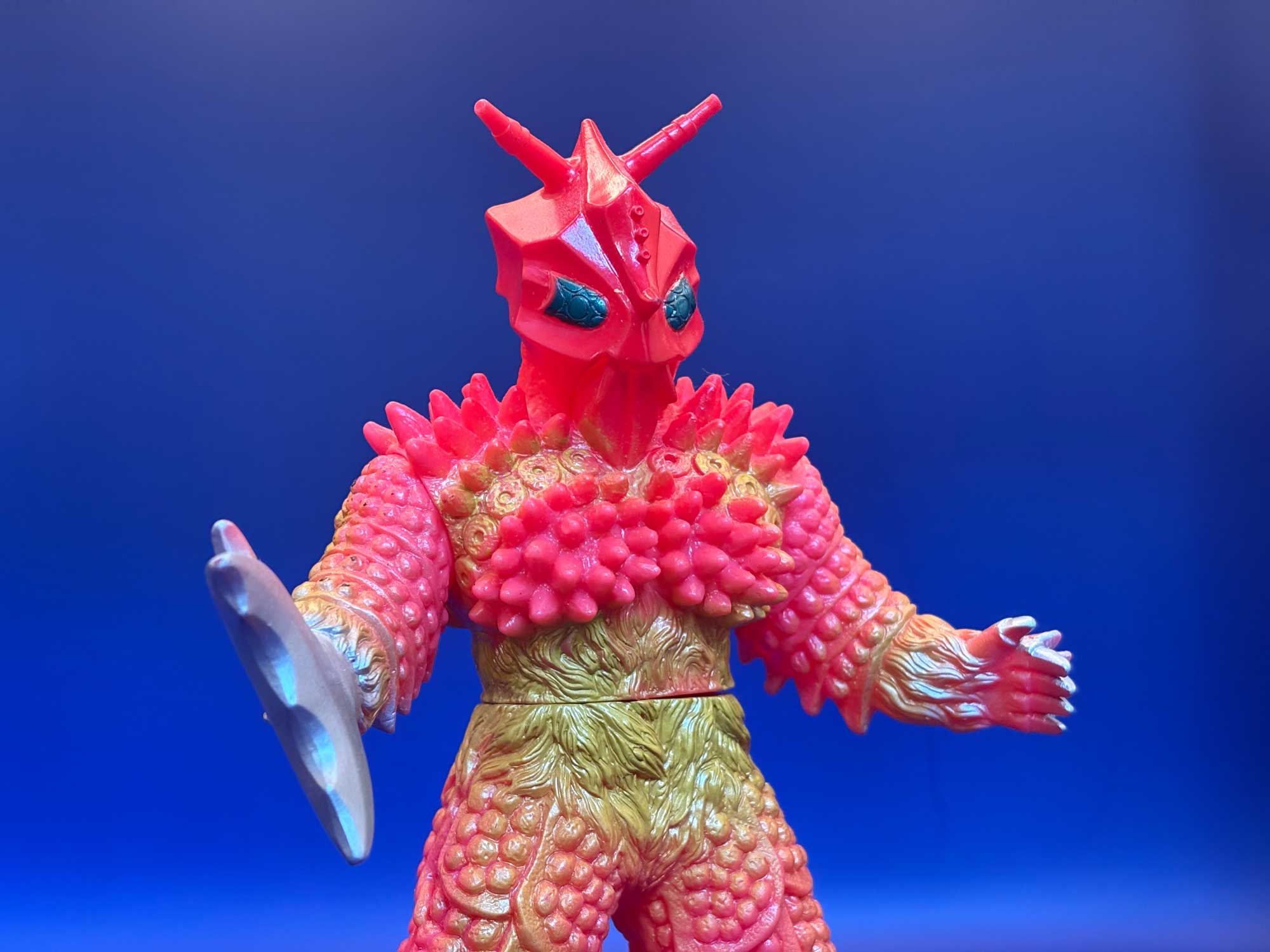
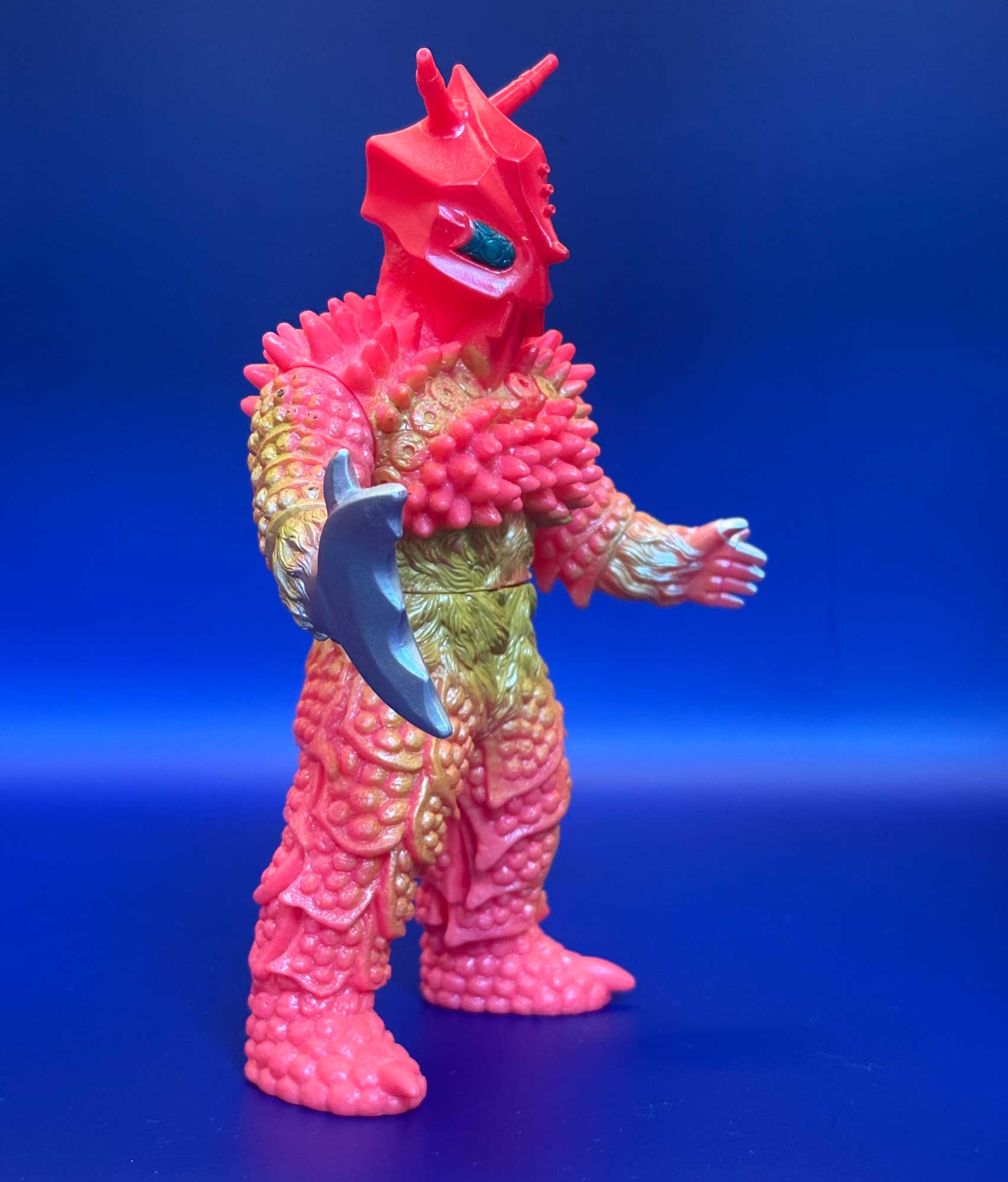
Not one company, and never has been. The chain splits into three jobs, and the figure in your hand has been through all of them.
Katsushika, Tokyo. Pouring, cooking and pulling by the same method it used when sofubi was first commercialised, in a residential back street.
Yotsugi, Tokyo. One man, an airbrush, a counter and seventy years. The step that decides what the thing actually looks like.
Founded by Tatsuhiko Akashi, and now past eight hundred products a year. The company that turned artist sofubi into a market with a price list.
The kaiju boom faded in the mid-1970s and took the toys with it. What revived sofubi was not nostalgia for monsters. It was fashion.
Through the 1980s the old figures became collectable, which kept the knowledge alive without making anything new. Then in the 1990s the Ura-Harajuku street labels started commissioning soft vinyl as part of their own world, and the designer sofubi era began: same material, same moulds, same workshops, but short runs made by named people rather than long runs made by a corporation.
Medicom opened in 1996. In 2014 it launched Vinyl Artist Gacha, five-hundred-yen capsule toys made with working artists, which put the form in front of an audience that had never heard of Bullmark. Around it a genuinely international set of makers grew up: Ayako Takagi, who developed Uamou while studying at Camberwell in London and now runs a shop near Akihabara; Cory Privitera of Science Patrol; Candie Bolton in Los Angeles, whose Bakekujira took the 2017 Designer Toy Award for soft vinyl; Aaron Wilkes of Sqdblstr, working out of GeGeGe no Kitaro and tsukumogami folklore; Remjie Malham; and Awesome Toy in Hong Kong.
What separates their work from a Showa shelf toy is not the process, which is unchanged, but the run. These are made in small numbers by individuals, often with something in the vinyl itself: glitter suspended in the pour, or phosphorescent powder so the figure holds light after dark. The figure is still hollow, still pulled by hand, still sprayed by somebody.
From an American fire-safety ruling to a capsule machine in Akihabara.
Goto works in front of visitors, so unusually for a vanishing craft there is real footage of it. These are collectors' own recordings, mostly Spanish-language, plus two on how the vinyl itself is made. They play inline here; the title opens the clip on YouTube.
The process is from a factory-floor report and the reference entry on the material. Everything about Goto Hiroshi is from published interviews and visits, including a first-hand account by the artist Ayako Takagi, who has had work painted in that workshop. Where a figure could not be confirmed in more than one place, the page says it is a guess.
A private collection that grew into something bigger. This is where it comes from, and what we hunt for.
What began as a handful of childhood pieces turned into a hunt: for the odd, the overlooked and the wonderfully strange. The finding, the careful cleaning, the search for a missing weapon or a lost accessory, the stories behind each toy. Somewhere along the way the collecting became a way of living.
We are drawn to the weird ones. Toys that were played with, loved and actually handled, over the pristine pieces sealed and graded never to be opened again. A toy locked in plastic, never to be read or felt, becomes a frozen artifact. We would rather keep them alive.
Have a collection of your own? We buy and take on whole collections and single pieces. Tell us what you have, send a few photos, and we will look after it.
Upload a few clear photos. Our AI identifies the toy, dates it, checks the condition and builds the listing for you. It also reviews recent sales to suggest a fair starting price.
Identification is free. You only use a listing when you decide to sell.
Add clear photos of the front, back, accessories and any visible flaws. Include a close-up of the maker's stamp where possible.
You can also add your own source or a note of direction, either to point us at something you already trust or to have the identification double-checked against it.
A worn or partly legible stamp is fine.
Our AI reads the toy the way Hammer & Mold does, dating it from the moulded stamp rather than the box, then identifies the year, line and variant, grades the condition and reviews recent sales to suggest a price.
You see the identification, the sources, the condition, the pricing and the listing details before anything goes live. Change what you like, set your Reserve or Buy Now price, then approve the listing.
Toy identification is free and unlimited. Photograph anything and we will identify it, date it, show what originally came with it and grade its condition. You only pay when you list. Choose a package based on how much you sell, or let us work out which one costs you least.
You do not have to run an auction to get rid of a box of toys. Send us photographs, we tell you what it is worth, and we make you an offer for the lot. You post one parcel and we pay. No listing, no waiting, no wondering whether it sells.
We would rather you picked the right one than the one that suits us, so here is the arithmetic on a toy we think will fetch €30.
| On a toy worth about €30 | Sell it to us | Sell it through us |
|---|---|---|
| You receive | € 15,00 | € 25,50 |
| When | Within a week | After it sells |
| If it does not sell | Our problem | You still have it |
| Photographs, listing, packing | We do it | You do it |
| If it turns out to be rare | We keep the upside | You keep it |
The honest reason: assessing one toy and assessing forty costs us nearly the same in setup, so a whole collection is worth far more of our attention than a single common figure.
1. You send photographs. A few clear shots of what you have, laid out. For anything you think is worth something, add a close-up of the moulded stamp on the feet or the lower back: that text is what lets us date it and find what it really sells for.
2. We tell you what it is, before we make an offer. You get the identification either way, and you keep it whether you sell to us or not. If we think a piece is worth more than we would pay for it, we will say so and tell you to list it yourself.
3. We make one offer for the lot. Within two working days, with the reasoning attached: what we think each piece fetches and what we are paying for it. No haggling and no fishing.
4. You post it, we pay. We send you a prepaid label. Payment goes out the day the parcel arrives and matches the photographs. If something is not as described you get the parcel back at our cost, not a lower offer.
Photographs and a way to reach you. Nothing else needed, and nothing is committed by sending it.
Toy identification is always free and unlimited. Photograph anything and we will tell you what it is, who made it, when it was made and what condition it is in. You only pay when you sell. Choose a package based on how much you sell each month. Every package includes price research, buyer protection and live postage rates.
Tell us roughly how much you sell. We will compare the monthly fee and selling fee together and recommend the cheapest package.
Compare what buyer and seller pay together. On a €100 hammer price, Catawiki charges the seller 12.5% and adds another 9% buyer fee. The buyer pays €109 while the seller receives €87,50. Hammer & Mold adds no buyer fee. A €100 hammer price means the buyer pays €100.
| On a €100 hammer price | Buyer pays | Seller receives | Total platform fees |
|---|---|---|---|
| Catawiki | € 109,00 | € 87,50 | 21,5% |
| Hammer & Mold, Starter | € 100,00 | € 85,00 | 15,0% |
| Hammer & Mold, Trader | € 100,00 | € 88,00 | 12,0% |
| Hammer & Mold, Dealer | € 100,00 | € 92,00 | 8,0% |
A monthly package fee buys you a lower selling fee. Sell enough in a month and the saving becomes greater than the subscription. Sell less, and Starter is cheaper. The table shows the total cost of each package at different monthly sales volumes.
Live lots from this seller.
Identifying a toy is free and unlimited on every package. A listing is what costs a token. Every package includes the price research, buyer protection on every lot, and postage quoted live from the carrier.